

Why addressing nutritional gaps boosts wellbeing after 50
TL;DR:
- Over half of adults over 50 experience silent nutritional deficiencies, increasing their health risks. Physiological changes reduce nutrient absorption, making deficiencies in vitamin B12, D, calcium, and protein common and serious if untreated. Personalized screening and targeted dietary and supplement strategies can effectively close these gaps, supporting healthier aging.
More than one in three adults over 50 live with a protein shortfall and many carry multiple nutritional gaps without realising it, even when their diet appears balanced. Silent deficiencies are not a fringe concern. They are a widespread, underrecognised condition that quietly raises the risk of serious illness, hospitalisation, and premature death. This article explains why nutritional gaps become more likely after 50, which nutrients are most often affected, what the consequences are if gaps go unaddressed, and how to identify and close them with practical, evidence-based steps.
Table of Contents
- What are nutritional gaps and why do they increase with age?
- The most common nutritional deficiencies in adults over 50
- What are the risks of ignoring nutritional gaps?
- How to identify and close your personal nutritional gaps
- Expert insights: why nutrition after 50 isn’t one-size-fits-all
- Take charge of your nutrition with trusted support
- Frequently asked questions
Key Takeaways
| Point | Details |
|---|---|
| Nutritional gaps increase with age | Digestive changes and higher micronutrient needs make deficiencies more common after 50. |
| Key risks from common deficiencies | Low B12, vitamin D, and protein threaten bone, brain, and muscular health as we age. |
| Testing and personalisation are vital | Biomarker-guided screening and personalised plans outperform guesswork or generic multivitamins. |
| Diet plus supplementation works best | A balanced, nutrient-rich diet combined with appropriate supplements can fill most gaps safely. |
| Monitor for both shortages and excess | Avoid over-supplementation—more isn’t always better for nutrients like calcium and vitamin D. |
What are nutritional gaps and why do they increase with age?
A nutritional gap exists when the body consistently receives less of a key nutrient than it needs for normal function, either due to insufficient dietary intake or impaired absorption. After 50, both problems intensify simultaneously, and that combination is what makes this stage of life particularly vulnerable.
Several physiological changes drive this increased risk. Stomach acid production declines, which reduces the body’s ability to extract B12 and minerals from food. Digestive enzyme output slows, meaning nutrients pass through the gut before they are fully processed. Muscle mass drops gradually, altering how the body uses protein and amino acids. And appetite often decreases, so even people who choose nutritious foods simply eat less of them.
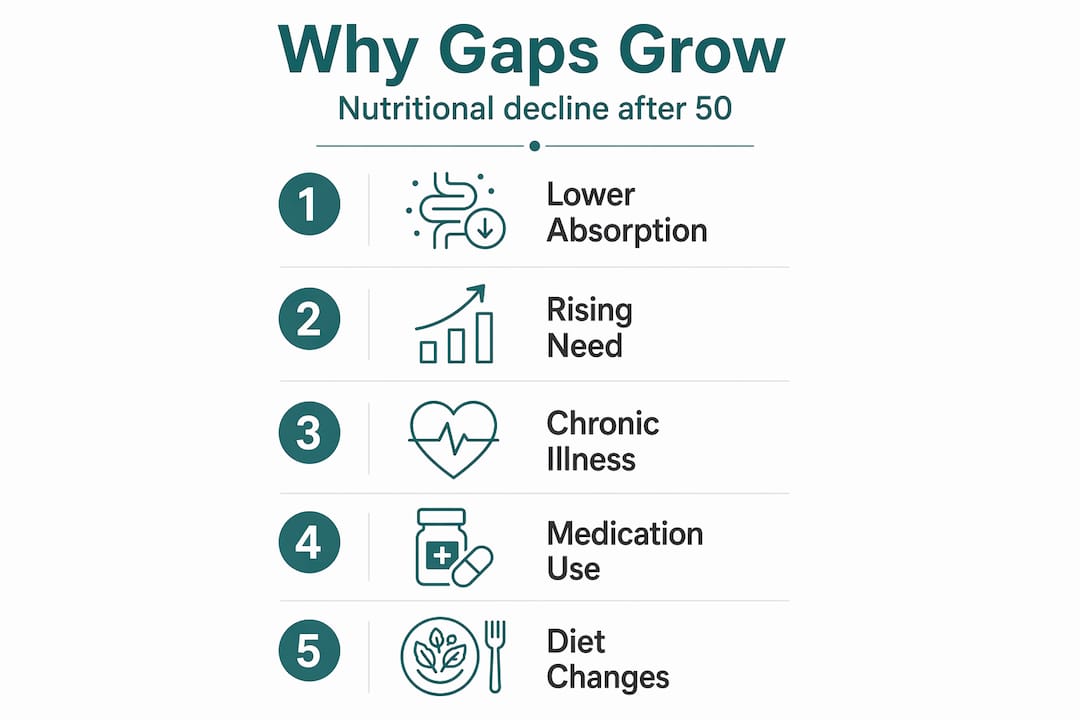
At the same time, the body’s demand for certain micronutrients actually increases. Cell repair mechanisms require more antioxidants and cofactors as mitochondrial function declines with age. The immune system needs consistent micronutrient support to remain effective. As our supplement guide for ageing outlines, nutritional gaps after 50 arise precisely because calorie needs fall while micronutrient needs remain constant or rise.
| Age-related change | Nutritional impact |
|---|---|
| Reduced stomach acid | Lower B12, iron, and calcium absorption |
| Slower digestion | Reduced nutrient extraction from whole foods |
| Declining muscle mass | Increased protein turnover and loss |
| Decreased appetite | Lower overall micronutrient intake |
| Reduced sun exposure | Vitamin D synthesis drops significantly |
| Mitochondrial decline | Greater need for antioxidants and B vitamins |
Key physiological drivers of nutritional gaps in adults over 50:
- Gastric atrophy reduces intrinsic factor, a protein essential for B12 absorption
- Lower physical activity reduces the metabolic stimulus for protein synthesis
- Chronic conditions and polypharmacy interfere with nutrient absorption and utilisation
- Socioeconomic factors, reduced mobility, and social isolation affect food variety and quantity
“Most older adults will experience at least one significant micronutrient deficiency, yet the majority remain undiagnosed until a more serious health event occurs.”
With this context in mind, let us examine which nutrients are most commonly lacking in those over 50.
The most common nutritional deficiencies in adults over 50
Four nutrients stand out consistently in clinical research as the most prevalent deficiencies in the over-50 population: vitamin B12, vitamin D, calcium, and protein. Each has its own absorption challenge, its own set of risk factors, and its own downstream health consequences.
B12 deficiency affects up to 43% of community-dwelling older adults, making it the single most common micronutrient deficiency in this age group. The NIH Office of Dietary Supplements confirms high deficiency rates for B12, calcium, vitamin D, and protein across older adult populations globally. The risk is not limited to vegans or those with obvious dietary restrictions. Many people eating meat and dairy regularly still become deficient because their gut can no longer absorb the protein-bound form of B12 found in food.
| Nutrient | Estimated deficiency rate (over 50) | Key risk factors |
|---|---|---|
| Vitamin B12 | Up to 43% | PPIs, metformin, low stomach acid, vegan diet |
| Vitamin D | 40–60% | Low sun exposure, darker skin, obesity |
| Calcium | 30–50% | Low dairy intake, malabsorption, diuretics |
| Protein | 1 in 3 adults | Appetite loss, chronic illness, plant-only diet |
Certain medications significantly increase deficiency risk. Proton pump inhibitors (PPIs), commonly prescribed for acid reflux, block the stomach acid needed to release B12 from food. Statins can interfere with CoQ10 synthesis. Metformin, used for type 2 diabetes, reduces B12 absorption markedly. If you take any of these medications regularly, your risk of a silent deficiency is considerably higher than average.
The health consequences are not subtle. Poor vitamin B12 status impairs nerve function and red blood cell production. Low vitamin D compromises calcium absorption, bone density, and immune regulation. Inadequate protein intake accelerates the muscle loss known as sarcopenia. For vitamin priorities after 50, understanding the interaction between these four nutrients is essential, not just addressing each in isolation.
The four most common deficiency warning signs to watch for:
- Persistent fatigue or weakness that does not improve with rest (often B12 or iron)
- Frequent infections or slow wound healing (vitamin D, zinc, and protein deficiency)
- Muscle cramps, bone pain, or reduced grip strength (calcium, vitamin D, protein)
- Memory lapses, difficulty concentrating, or low mood (B12, omega-3, folate)
Pro Tip: Arrange a baseline blood test with your GP before starting any new supplement. Key panels include serum B12, 25-hydroxyvitamin D (25OHD), methylmalonic acid, ferritin, and a full blood count. Results allow targeted action rather than guesswork.
Knowing which deficiencies are most prevalent helps clarify why they are so critical to address. But what actually happens if they go unrecognised?
What are the risks of ignoring nutritional gaps?
The risks of untreated nutritional deficiencies range from everyday fatigue to life-altering illness. Untreated gaps can lead to fatigue, muscle wasting, osteoporosis, anaemia, cognitive impairment, frailty, and increased mortality, with clinical evidence linking each deficiency to a specific pattern of deterioration.
Short-term consequences tend to be dismissed as normal ageing: low energy, slower recovery from minor illness, increased sensitivity to cold, and general sluggishness. These are real physiological signals, not inevitable features of getting older. Medium and long-term consequences are more severe.
- Sarcopenia: Progressive muscle loss accelerates without adequate protein and vitamin D, increasing fall risk significantly
- Osteoporosis: Calcium and vitamin D deficiency weaken bone density, raising fracture risk even from minor impact
- Anaemia: B12 and iron deficiency reduce red blood cell production, leading to chronic fatigue and breathlessness
- Cognitive decline: Low B12, folate, and omega-3 levels are consistently linked to faster memory deterioration
- Immune decline: Zinc, selenium, and vitamin D gaps leave the body less equipped to manage infections or inflammation
- Frailty: A combination of deficiencies converges to create the frailty syndrome, characterised by low energy, weakness, and reduced resilience
“Over 30% of adults over 65 experience at least one significant nutritional deficiency, and those with multiple deficiencies face disproportionately higher risks of hospitalisation and early death.”
People with chronic illness, depression, limited mobility, or restrictive diets face compounding risks. Depression reduces appetite and motivation to cook. Chronic illness increases nutrient demands while often reducing absorption. Limited mobility cuts sunlight exposure, directly suppressing vitamin D synthesis. For a clear view of which science-backed supplements address these specific risks most effectively, the clinical evidence is now extensive and well-organised.
Addressing the risks means taking practical steps. How can you effectively close these gaps in everyday life?

How to identify and close your personal nutritional gaps
The first step is identification. The SCREEN tool (Seniors in the Community: Risk Evaluation for Eating and Nutrition) is a validated self-screening instrument that flags nutritional risk without a blood test. It covers appetite, weight changes, meal frequency, and food access, providing a quick initial snapshot. However, it works best as a starting point, not a substitute for clinical testing.
Blood biomarkers and individualised routines are the most reliable methods for identifying and closing gaps. A basic panel from your GP should include serum B12, 25OHD (vitamin D), methylmalonic acid (a more sensitive B12 marker), ferritin, and a full metabolic panel. Annual testing is reasonable for most adults over 55. Six-monthly reviews may be appropriate if you take medications that affect absorption.
Steps to build a personalised gap-closing plan:
- Screen first. Use the SCREEN tool or speak with your GP to establish where you currently stand before making dietary or supplement changes.
- Prioritise dietary quality. Focus on nutrient-dense foods: oily fish for omega-3 and vitamin D, eggs and lean meat for B12 and protein, leafy greens for folate and calcium, and pulses for additional protein and iron.
- Add fortified foods strategically. Fortified plant milks, breakfast cereals, and spreads can close specific gaps without adding excess calories.
- Choose bioavailable supplement forms. Nutrient-dense diets and bioavailable supplements such as liposomal B12, vitamin D3 combined with K2, and calcium citrate rather than carbonate are better absorbed after 50.
- Monitor and adjust. Retest every six to twelve months to confirm gaps are closing, and adjust dosages accordingly.
Pro Tip: Combine dietary changes with moderate resistance exercise. Exercise stimulates protein synthesis and helps the body use nutrients more efficiently, especially for muscle and bone maintenance. A supplement programme without physical activity delivers a fraction of its potential benefit.
Simple daily practices to reduce deficiency risk:
- Eat at least two portions of protein-rich food per day (eggs, fish, legumes, or lean meat)
- Spend 15 to 20 minutes outdoors in direct sunlight when possible, especially between March and October
- Avoid taking calcium and iron supplements at the same time, as they compete for absorption
- Review all medications with your GP or pharmacist annually for nutrient depletion interactions
- Read labels when selecting nutritional products to identify bioavailable forms versus cheaper alternatives
- Consider a top products for healthy ageing review to match specific products to your identified gaps
Even with sound advice, there are nuanced debates around precision nutrition and the best ways to address these gaps. Here is what most guides miss.
Expert insights: why nutrition after 50 isn’t one-size-fits-all
Most nutritional guidelines are written for population averages. They serve a useful public health function, but they are not designed to account for individual variation in genetics, gut microbiome composition, medication history, chronic illness burden, or lifestyle. After 50, this limitation becomes more clinically significant, not less.
Standard multivitamins, for example, are formulated around the broad needs of adults from 19 to 70. They rarely account for the reduced gastric acid of a 65-year-old, or the increased B12 requirement of someone on long-term metformin. Bioavailable forms and biomarker-guided approaches consistently outperform generic supplementation strategies, both in absorption efficiency and measurable health outcomes.
Clinical trials for supplements show mixed results precisely because they often test standardised doses in heterogeneous populations. One person’s optimal vitamin D dose is another person’s underdose. Protein needs, in particular, often exceed the standard RDA for older adults, with emerging research suggesting that 1.2 to 1.6 grams per kilogram of body weight is more appropriate than the conventional 0.8 grams per kilogram recommendation, especially for maintaining muscle.
The future of post-50 nutrition is moving towards genomic and biomarker-driven personalisation. Genetic variants influence how individuals metabolise folate, vitamin D, omega-3, and B vitamins. Digital health platforms can now integrate dietary intake data with biomarker tracking to generate targeted recommendations. This is not science fiction. It is available now, though not yet standard practice in most healthcare settings. Reviewing supplement safety tips before combining multiple products is a practical first step in this direction.
The hard-won lesson from current evidence is this: maintenance beats quick fixes, and excess carries its own risks. Toxicity from fat-soluble vitamins such as A, D, and K is real and measurable. Excessive calcium supplementation can raise cardiovascular risk. The goal is consistent, calibrated sufficiency, not maximum dosing.
Take charge of your nutrition with trusted support
Closing nutritional gaps is one of the most effective actions you can take for independent, healthy ageing. The evidence is clear. Deficiencies are common, often silent, and genuinely harmful over time, but they are also identifiable and correctable with the right approach.

Vivetus® offers a curated range of science-backed supplements, in-depth educational guides, and practical planning resources designed specifically for adults over 50. Whether you are starting with a blood test, reassessing your current supplement routine, or looking for bioavailable forms of key nutrients, Vivetus® provides the information and products to support informed decisions. Explore the full range at vivetus.eu and take a structured, evidence-based approach to your nutritional health today. Free shipping is available on orders over €50.
Frequently asked questions
How do I know if I have nutritional gaps?
The best approach is to combine symptom monitoring with periodic blood tests covering B12, vitamin D, and other key nutrients. Blood biomarkers for personalisation are the most reliable way to confirm and track deficiencies accurately.
Which supplement forms are best for absorption in older adults?
Bioavailable forms such as crystalline B12, liposomal vitamin D3, and calcium citrate are typically better absorbed after age 50. Specialised delivery forms improve absorption significantly when standard forms are less effective due to reduced stomach acid.
Can dietary changes alone fully address post-50 nutritional gaps?
For many people, especially those with chronic illness or malabsorption, diet alone is usually insufficient. Diet alone post-50 often needs to be supported by targeted supplementation and fortified foods to reliably close key gaps.
Is there a risk of too much calcium or vitamin D from supplements?
Yes. Excess supplementation can increase the risk of kidney stones, arterial calcification, and falls. Excess calcium and vitamin D risks are well-documented, making correct dosing based on blood test results essential rather than optional.