

Calcium supplements benefits: a guide for women over 40
TL;DR:
- Meeting your daily calcium needs after 40 is challenging as bone density declines more sharply post-menopause. Proper supplement selection, timing, and addressing dietary gaps are essential, with calcium citrate preferred for better absorption in older women. While supplements offer modest fracture risk reduction, maintaining a balanced approach with diet, vitamin D, exercise, and individualized medical advice is crucial for optimal bone health.
Meeting your daily calcium needs after 40 is harder than most advice suggests. Bone density begins declining in your mid-30s, and by the time you reach menopause, that process accelerates sharply. Understanding the calcium supplements benefits that matter most requires more than a basic “take your vitamins” approach. This article covers what to look for in a supplement, which forms absorb best, the real evidence on fracture prevention, and when supplementing genuinely helps versus when your diet should do the work.
Table of Contents
- Key criteria for choosing calcium supplements
- Types of calcium supplements and their benefits
- Comparison of calcium supplement benefits and risks
- How to optimise benefits from calcium supplements
- Situational recommendations: when calcium supplements make sense
- Rethinking calcium supplements: a balanced approach for women over 40
- Support your bone health journey with Vivetus
- Frequently asked questions
Key Takeaways
| Point | Details |
|---|---|
| Calcium needs rise with age | Women over 50 generally require 1,200 mg calcium daily, prioritising dietary sources. |
| Supplement wisely | Choose calcium form and dosing carefully to improve absorption and avoid excess intake risks. |
| Balanced approach essential | Bone health depends on calcium plus muscle strength, vitamin D, and fall prevention strategies. |
| Monitor total intake | Avoid surpassing 2,000 mg/day of calcium to reduce risks of kidney stones and cardiovascular issues. |
| Personalise supplementation | Consult healthcare professionals to tailor calcium supplements to your health profile and lifestyle. |
Key criteria for choosing calcium supplements
Before adding any supplement to your routine, it helps to understand what you are actually trying to achieve and whether a supplement is the right tool to get there.
Know your daily target. Women aged 51 and older require 1,200 mg of total calcium per day. That figure includes everything you consume through food and supplements combined. Supplements are recommended only when dietary intake consistently falls short of that threshold.
Food first, supplements second. Dairy products, fortified plant milks, tinned sardines with bones, and leafy greens such as kale and bok choy all provide well-absorbed calcium. The nutritional supplements advantages come into play when diet alone cannot reliably close the gap, not as a replacement for varied eating.
Key selection criteria at a glance:
- Total daily calcium from all sources should stay below 2,500 mg/day for adults under 51, and below 2,000 mg/day for women 51 and older
- Choose a supplement that specifies elemental calcium content, not just the compound weight
- Pair calcium with vitamin D, which is essential for calcium absorption and bone mineralisation
- Avoid megadose single servings; the body absorbs no more than 500 mg of elemental calcium in one sitting
Pro Tip: Before purchasing any supplement, log your dietary calcium intake for three days using a nutrition tracking app. Many women already reach 700 to 900 mg through food alone and need only a modest top-up.
Types of calcium supplements and their benefits
Not all calcium supplements are equivalent. The form of calcium in your tablet determines how well your body absorbs it, when you should take it, and how much elemental calcium you actually receive per dose.
Calcium carbonate is the most widely available form. It contains 40% elemental calcium and requires food to stimulate stomach acid for proper breakdown. If you take it on an empty stomach, absorption drops considerably. This form works well if your digestion is functioning normally.
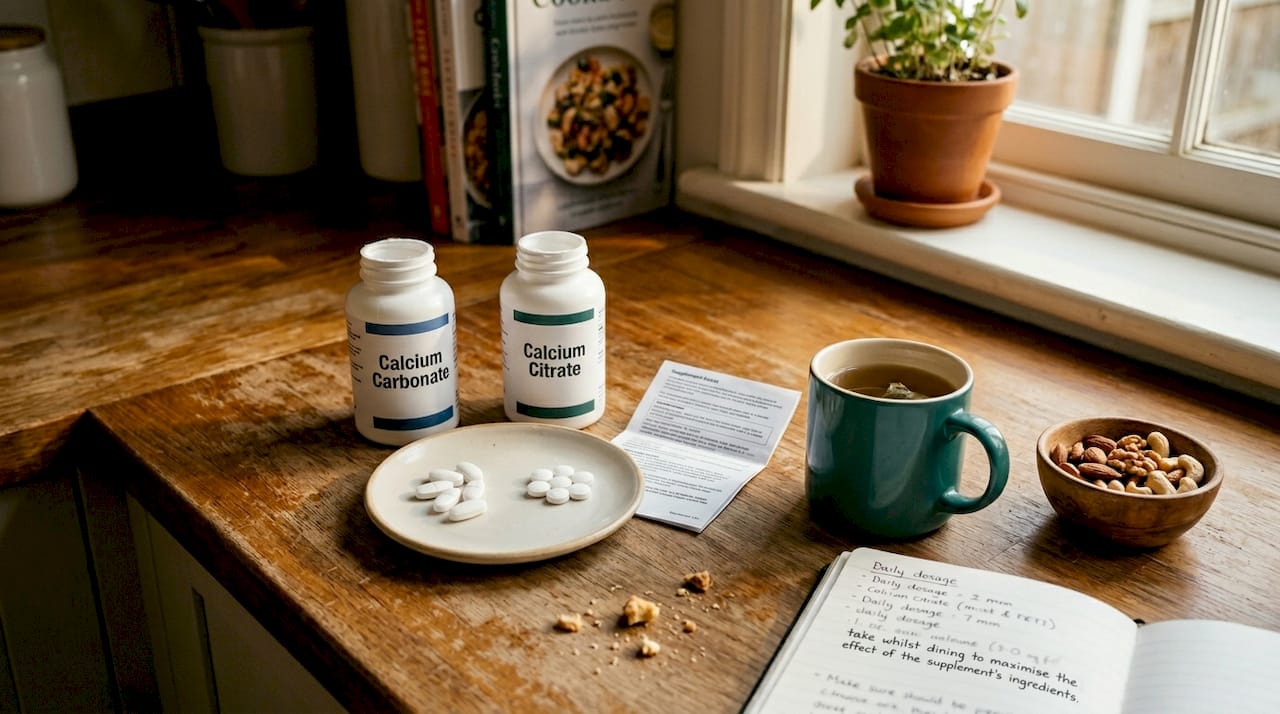
Calcium citrate is the preferred option for women over 40. Stomach acid production naturally decreases with age, and calcium citrate does not rely on it. It can be taken with or without food, and calcium citrate absorbs 22 to 27% better than carbonate in people with low stomach acid, a condition increasingly common after 40. The trade-off is that citrate tablets contain roughly 21% elemental calcium, so you may need more tablets to reach the same dose.
Common calcium supplement types compared:
- Calcium carbonate: 40% elemental calcium, take with food, lower cost, widely available
- Calcium citrate: 21% elemental calcium, take any time, better for reduced stomach acid
- Calcium gluconate: 9% elemental calcium, generally used in medical settings rather than daily supplements
- Calcium lactate: 13% elemental calcium, moderate absorption, less commonly available
Dosing and timing rules:
- Split doses into no more than 500 mg of elemental calcium per serving
- Space doses at least four hours apart for maximum uptake
- Do not take calcium supplements at the same time as iron supplements, as they compete for absorption
Explore the healthy ageing supplements guide for a broader view of how calcium fits within a full supplement regimen for women at this life stage.
Comparison of calcium supplement benefits and risks
The calcium supplement advantages are real but more modest than the marketing often implies. A clear-eyed comparison helps you decide how much supplementation is appropriate.
| Factor | Calcium supplements | Dietary calcium |
|---|---|---|
| Fracture risk reduction | 7% modest reduction overall | Consistent protective association |
| Hip and spinal fracture benefit | No clear evidence | Moderate long-term support |
| Cardiovascular risk | 10 to 20% higher heart attack risk | No increased risk |
| Kidney stone risk | Elevated with high doses | Low risk, may even be protective |
| Convenience | High; fixed dosing | Dependent on diet quality |
| Nutrient co-factors | Requires deliberate pairing | Naturally present in whole foods |
What the evidence shows:
- A 2025 meta-analysis found a 7% reduction in overall fracture risk with calcium supplements but high-dose supplements linked to kidney stones and increased cardiovascular concerns
- The heart risk applies specifically to supplemental calcium, not calcium obtained through food
- Women with established osteoporosis or very low dietary intake see the most measurable benefit from supplementation
“The evidence consistently shows that exceeding calcium requirements through supplementation does not produce proportionally greater bone benefits, but it does increase the likelihood of harm.” This principle should sit at the centre of every supplementation decision.
Pro Tip: If your GP has recommended a statin or other cardiovascular medication, specifically discuss calcium supplementation before starting. The interaction between elevated supplemental calcium and cardiovascular risk is clinically relevant in this group.
Review supplement safety tips for practical guidance on monitoring total intake and avoiding common supplementation errors.
How to optimise benefits from calcium supplements
Knowing that calcium supplements can help is only the starting point. How you take them determines whether they actually deliver the calcium health benefits you are looking for.
Step-by-step approach to effective supplementation:
- Calculate your current dietary calcium intake before determining supplement dose
- Choose calcium citrate if you are over 40 or take acid-reducing medication (PPIs, H2 blockers)
- Split doses to 500 mg elemental calcium or less, taken at separate meals
- Take calcium with vitamin D, either as a combined supplement or separately
- Avoid taking calcium alongside high-fibre meals, as phytates in whole grains can reduce absorption
- Review your total intake every six months as dietary patterns change
Nutrients that work alongside calcium:
- Vitamin D: Directly regulates calcium absorption in the intestine; without adequate vitamin D, even a well-chosen supplement underperforms
- Magnesium: Assists in converting vitamin D to its active form; deficiency is common in women over 40
- Vitamin K2: Directs calcium to bone rather than soft tissue; found in fermented foods and available as a supplement
- Potassium: Reduces urinary calcium loss, effectively increasing calcium retention in bone
Exercise matters as much as supplementation. Weight-bearing activity, brisk walking, resistance training, and balance work all stimulate bone remodelling in ways that calcium alone cannot replicate. In women over 60, combining 500 mg calcium with 200 IU vitamin D twice daily reduced hip fractures by 23% over seven years, but participants also maintained general activity levels throughout the study.
Pro Tip: Start calcium supplementation only if your dietary intake is consistently below 700 mg per day. Prioritising diet quality first, then adding a modest supplement dose, produces better outcomes than relying on a high-dose supplement to compensate for a poor diet.
Situational recommendations: when calcium supplements make sense
Calcium supplements are not universally necessary. The decision depends on your dietary intake, life stage, and specific health conditions.
When supplements are genuinely indicated:
- Women over 50 with dietary calcium consistently below 1,000 mg/day; supplements advised if dietary intake falls short to reduce osteoporosis risk
- Diagnosed lactose intolerance or dairy avoidance without alternative calcium sources
- Absorption conditions such as coeliac disease, inflammatory bowel disease, or gastric bypass surgery
- Women with low stomach acid (often confirmed by response to digestive symptoms) who benefit from citrate form
- Pregnant women with low dietary calcium, where 1,500 to 2,000 mg/day is recommended to reduce preeclampsia risk
When diet is likely sufficient:
- Women who regularly consume dairy, fortified foods, and a variety of vegetables
- Those already meeting the 1,200 mg/day target through food tracking
- Healthy older adults without diagnosed deficiency; routine supplementation shows insufficient evidence for reducing falls, fractures, or mortality in this group
| Life stage | Recommended intake | Supplement indicated? | Notes |
|---|---|---|---|
| Women 19 to 50 | 1,000 mg/day | Only if dietary gap exists | Monitor total intake |
| Women 51 and older | 1,200 mg/day | Yes, if diet below 1,000 mg | Prefer citrate form |
| Pregnant women | 1,000 to 1,300 mg/day | Yes, if intake is low | Risk of preeclampsia |
| Low stomach acid | Any age | Yes | Citrate form essential |
| Post-gastric bypass | Any age | Yes, with medical supervision | Absorption severely reduced |
For a broader view of supplementation across life stages, the supplements guide for ageing provides additional context on timing and individual variation.
Rethinking calcium supplements: a balanced approach for women over 40
There is a version of calcium advice that has been repeated for decades: take your calcium, keep your bones strong, prevent fractures. It is not wrong, but it is incomplete in ways that matter.
Bone strength is not a single-nutrient problem. It depends on muscle mass, physical activity levels, vitamin D status, hormone balance, and fall prevention as much as it depends on calcium intake. Women who prioritise resistance training and maintain adequate protein alongside modest calcium supplementation tend to have better bone outcomes than those who rely heavily on supplements while remaining sedentary.
The cardiovascular concern is real and should not be dismissed. The evidence consistently points to calcium as essential but never sufficient on its own; bone maintenance via diet, muscle strength, and fall prevention produces the best outcomes. This is not a reason to avoid supplements when they are appropriate. It is a reason to use the lowest effective dose and to measure your actual dietary intake before assuming you need a supplement at all.
Bones are living tissue. They respond to load, to nutrition, and to hormonal signals. Treating them as mineral stores that simply need topping up with calcium misses the complexity of what keeps them resilient as you age.
Over-supplementing is a surprisingly common pattern. Women who take 1,000 mg supplemental calcium per day on top of a diet that already delivers 800 mg are not twice as protected; they are simply exceeding safe thresholds and adding unnecessary cardiovascular and renal risk. The goal is sufficiency, not excess.
The practical conclusion is straightforward: aim for a nutritional supplements overview that positions calcium as one component of bone health, not the whole solution. Supplement to close a genuine dietary gap. Combine it with vitamin D, K2, and weight-bearing exercise. Keep total daily intake within recommended limits. That approach delivers real, measurable calcium absorption benefits without the risks that come from treating supplements as a shortcut.
Support your bone health journey with Vivetus
Understanding the calcium supplements benefits that are relevant to your specific situation is the first step. Taking action with the right products and reliable information is the second.
Vivetus offers a curated selection of evidence-backed supplements designed specifically for healthy ageing and bone support. From calcium citrate formulations with added vitamin D3 and K2, to comprehensive guides on supplement safety and efficacy for women over 40, everything is selected with current research in mind. The nutritional supplements advantages page provides a broader look at how supplementation fits within a science-supported approach to vitality. For a structured starting point, the healthy ageing supplements guide covers how to build a supplement regimen that is both safe and effective at this stage of life.
Frequently asked questions
How much calcium do women over 50 need daily?
Women aged 51 and older require 1,200 mg of total calcium per day, ideally from a combination of dietary sources and supplements when food intake falls short.
Are calcium supplements safe for heart health?
Calcium supplements carry a 10 to 20% higher heart attack risk compared to dietary calcium, so keeping supplemental doses modest and monitoring total intake is important, particularly for women with existing cardiovascular risk factors.
What is the best form of calcium supplement for absorption?
Calcium citrate absorbs 22 to 27% better than calcium carbonate in people with reduced stomach acid, which makes it the preferred option for most women over 40; carbonate remains effective if taken consistently with meals.
Can calcium supplements help prevent fractures?
A 7% reduction in overall fracture risk is associated with calcium supplementation, but no clear benefit has been demonstrated for hip or spinal fractures specifically, which are the most clinically significant fracture sites in older women.