

Supplement timing: Key facts for better health in 2026
TL;DR:
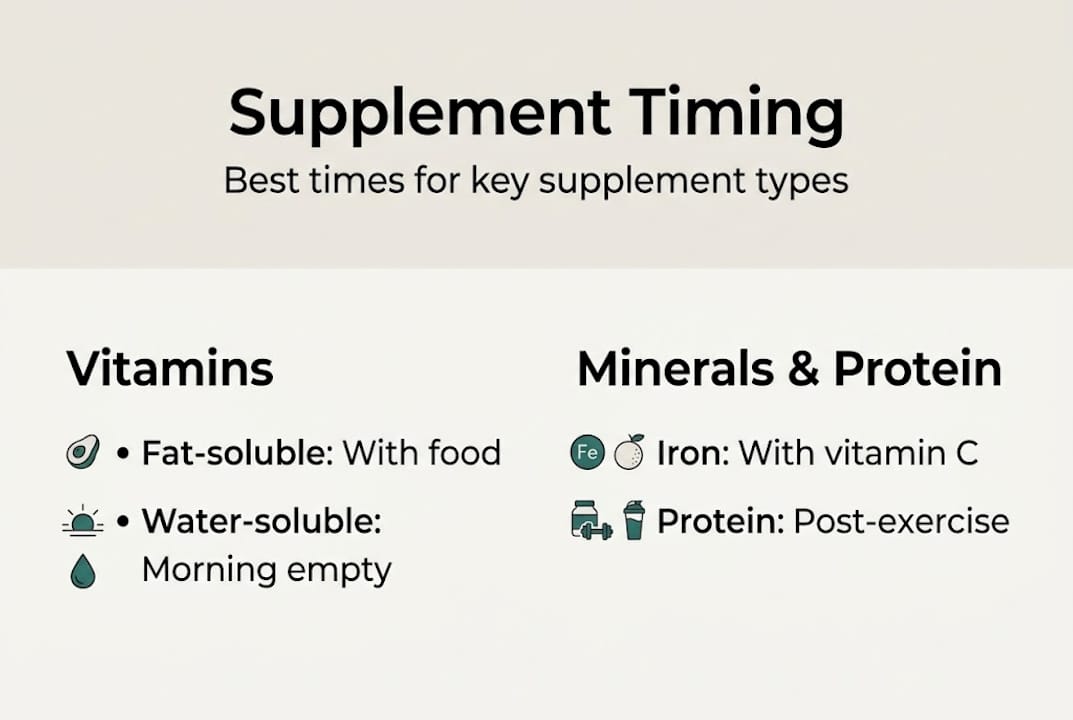
- Supplement timing affects absorption, with fat-soluble vitamins best taken with food and water-soluble vitamins on an empty stomach.
- Consistency over exact timing is more important, but strategic placement around meals enhances effectiveness.
- Proper scheduling, such as spacing iron and calcium intake, maximizes nutrient absorption and minimizes side effects.
Most people assume that swallowing their supplements at any point in the day is good enough. It is not quite that simple. Research shows that absorption and benefits vary significantly depending on when you take a nutrient, what you eat alongside it, and how your body’s internal clock is functioning at that moment. For health-conscious adults and seniors focused on vitality and healthy ageing, these details are not trivial. This article sets out the evidence, corrects common misconceptions, and gives you a clear, practical framework for getting the most from your supplements every single day.
Table of Contents
- Why supplement timing matters: More than a routine
- The science: Key evidence-backed timing rules
- Common pitfalls: Timing mistakes to avoid
- Consistency and practical routines: Making timing work for you
- A realistic perspective: Why strict timing isn’t everything
- Upgrade your vitality: Next steps
- Frequently asked questions
Key Takeaways
| Point | Details |
|---|---|
| Absorption depends on timing | Supplements like fat-soluble vitamins are best absorbed with meals, especially those containing fat. |
| Avoid key interaction mistakes | Separate iron and calcium doses to prevent reduced absorption and maximise benefits. |
| Consistency trumps perfection | It’s better to build a routine you can maintain than to chase the ‘perfect’ minute for each supplement. |
| Post-exercise window matters | Protein and carbohydrate supplements support recovery when taken soon after exercise. |
Why supplement timing matters: More than a routine
Timing is not just a preference. It is a mechanism. The body absorbs nutrients differently depending on the presence of food, fat, digestive enzymes, and even the time of day. This is not marketing language. It is basic physiology, and understanding it can meaningfully improve the results you get from your supplements.
The central concept here is bioavailability, which simply means how much of a nutrient your body actually absorbs and uses. Several factors shape this:
- Fat-soluble vitamins (A, D, E, and K) require dietary fat to be absorbed properly. Taking them on an empty stomach wastes a significant portion of the dose.
- Water-soluble vitamins (B vitamins and vitamin C) are generally absorbed well without food, though some cause nausea on an empty stomach.
- Minerals such as iron and magnesium compete with each other for absorption pathways, so spacing them out matters.
- Energising supplements like B vitamins or ginseng are best taken in the morning to align with your natural energy cycle.
As one key principle states, optimal bioavailability depends on taking fat-soluble vitamins with food and water-soluble vitamins on an empty stomach.
Your body also runs on a circadian rhythm, an internal 24-hour clock that governs everything from hormone release to gut motility. Certain supplements interact with this rhythm. Melatonin, for instance, only makes sense in the evening. Stimulating adaptogens work better in the morning. Understanding morning vs. evening supplement timing can help you align your routine with these biological signals.
That said, not every supplement demands obsessive precision. For many nutrients, consistency across days and weeks matters far more than hitting an exact hour. If you are exploring supplements for healthy ageing, this balance between precision and practicality is the right starting point.
Timing is not about perfection. It is about understanding your body well enough to give your supplements a genuine chance to work.
The science: Key evidence-backed timing rules
Not all supplements follow the same rules. Here is a breakdown by category, based on current evidence.
Fat-soluble vitamins (A, D, E, K)
These vitamins are absorbed up to 50% more effectively when taken with the largest meal of the day, particularly one containing dietary fat. A meal with olive oil, avocado, or oily fish provides an ideal vehicle. Vitamin D is particularly susceptible to this effect, as its absorption drops sharply when taken fasting.
Water-soluble vitamins (B and C)
B vitamins and vitamin C absorb well on an empty stomach, and B vitamins are best taken in the morning. This is because the B group supports energy metabolism and cellular function, processes that run most actively during the day. Taking them in the evening serves little purpose and may interfere with sleep.
Minerals
Mineral timing requires care, especially when multiple minerals are part of your routine. Iron absorbs better alongside vitamin C, which enhances uptake. Pairing them is a simple but effective strategy for supplement synergy. However, do not take iron and calcium together, as they compete for the same absorption pathway.
Protein and post-exercise nutrition
Exercise supplementation research confirms that the post-exercise window, typically within 30 to 60 minutes of training, is the most effective time to consume protein. Muscle protein synthesis is elevated during this period, making nutrient delivery more productive.

A practical comparison
| Supplement type | Best timing | Take with |
|---|---|---|
| Fat-soluble vitamins | Morning or lunch | Fatty meal |
| B vitamins | Morning | Empty stomach or light meal |
| Vitamin C | Anytime | Empty stomach or with iron |
| Iron | Morning | Vitamin C, away from calcium |
| Protein | Post-exercise | Water or milk |
| Multivitamin | Main meal | Food |
Pro Tip: If you are unsure where to begin, choosing the right supplements for your specific health goals is the logical first step before worrying about exact timing.
For seniors, there is an additional consideration. Gastric acid production declines with age, which reduces the absorption of certain nutrients, including B12 and magnesium. Taking these with meals when digestive activity is highest can partially compensate.
Common pitfalls: Timing mistakes to avoid
Knowing the right steps helps, but sidestepping mistakes makes the benefits stick. Several common errors reduce the effectiveness of supplements or, in some cases, cause side effects that are entirely avoidable.
The most frequent mistakes:
- Taking iron and calcium together. Calcium can reduce iron absorption by as much as 50%. These two minerals should be spaced at least two hours apart.
- Taking B vitamins in the evening. B vitamins boost energy metabolism and can interfere with sleep if taken too late in the day.
- Assuming more protein means more muscle. Protein supplements show no consistent muscle gain in healthy seniors when overall diet is adequate. Dose and distribution matter more than quantity alone.
- Ignoring fat intake with fat-soluble vitamins. Without dietary fat, a significant portion of vitamin D, E, A, and K simply passes through unabsorbed.
- Skipping days and doubling up. Taking two doses at once to compensate for a missed day does not restore lost absorption opportunities and may cause digestive discomfort.
Statistic to note: Calcium can cut iron absorption by up to 50%, making mineral scheduling one of the most impactful timing decisions you can make.
For broader guidance on staying safe with your routine, the safe supplement use tips resource covers the most important precautions. The best practices for multivitamins are also worth reviewing, particularly if you take several supplements alongside a multivitamin.
Pro Tip: Use a simple pill organiser labelled by time of day, such as “morning with food” and “afternoon empty,” rather than by day. This makes timing intuitive without requiring memory effort.
Consistency and practical routines: Making timing work for you
Avoiding mistakes is important, but consistency brings lasting results. For most people, consistency across days matters more than hitting a precise hour, though aligning with daily habits and circadian rhythms does add measurable benefit over time.
The practical goal is to attach your supplement routine to existing habits so it becomes automatic. Here are three common frameworks:
- The breakfast anchor. Take fat-soluble vitamins and your multivitamin with your morning meal. If breakfast includes fat, such as eggs or nut butter, absorption improves immediately.
- The post-workout window. Take protein supplements within 60 minutes of exercise. This is the clearest case where timing has a direct physiological impact.
- The split routine. Take morning supplements with breakfast and evening supplements, such as magnesium or omega-3, with your evening meal. This works well for those taking five or more supplements.
Sample daily routine
| Time | Supplement | Condition |
|---|---|---|
| Morning, with breakfast | Vitamin D, multivitamin, B complex | Fatty meal present |
| Mid-morning | Iron, vitamin C | Empty stomach, away from calcium |
| Post-exercise | Protein supplement | Within 60 minutes of training |
| Evening meal | Omega-3, magnesium | With food |
For evidence-backed choices that fit your ageing goals, this kind of structured routine is far more effective than guesswork. You can also find tips for multivitamin routines that adapt to different lifestyles and meal patterns.
Pro Tip: Set two daily phone reminders labelled “morning supplements” and “evening supplements” rather than trying to remember individually. The habit forms within two to three weeks for most people.
A realistic perspective: Why strict timing isn’t everything
Before you restructure your entire day around supplement schedules, it is worth being direct about what the evidence actually shows. Limited research supports strict timing benefits for most standard supplements. The gains from obsessing over minutes on the clock are real but modest.
What matters far more is whether you take your supplements at all, consistently, over months and years. A vitamin D capsule taken at noon rather than 8am is still doing its job. An omega-3 taken with lunch instead of dinner is still reducing inflammation. The body is not a rigid machine.
The smarter approach is to use timing rules as a framework, not a rigid law. Prioritise the high-impact decisions, such as taking fat-soluble vitamins with fat, separating iron from calcium, and keeping B vitamins to the morning. For everything else, fit your supplements around your life, not the other way around. The longevity supplement evidence consistently points to sustained habits as the primary driver of results.
Upgrade your vitality: Next steps
Applying the timing strategies in this article gives your supplements a genuine advantage. The next step is making sure the products in your routine are formulated to support your specific vitality and ageing goals.
At Vivetus, you will find a curated range of scientifically supported supplements designed for healthy ageing. Whether you are building a routine from scratch or refining an existing one, the Energy and Vitality bundle offers a practical starting point. Orders over €50 include free shipping, and the product range is accessible across Europe. Apply what you have learned here and let your routine work harder for you.
Frequently asked questions
Are there supplements that must be taken at exactly the same time daily?
Only a few, such as certain prescription-strength formulations; for most supplements, no strong evidence supports strict timing outside specific medical contexts, and consistency across days matters far more than hitting a precise hour.
Can taking supplements at the wrong time be harmful?
Most timing errors reduce effectiveness rather than cause harm, but B vitamins in the evening are a notable exception, as they can disrupt sleep quality in some individuals.
Is it better to take all my supplements at once or split them?
Splitting supplements, particularly minerals that interact, improves absorption and reduces digestive side effects; taking iron and calcium separately is one of the clearest examples where spacing makes a measurable difference.
Does supplement timing matter for older adults?
Yes, particularly for multivitamins, which are better tolerated with meals and may absorb more effectively alongside food; however, no consistent muscle benefit has been found for protein supplements in otherwise healthy seniors with adequate dietary intake.