

Apigénine : science, bienfaits et guide du vieillissement en bonne santé
En résumé :
- L’apigénine est un flavonoïde d’origine végétale aux propriétés antioxydantes et anti-inflammatoires.
- Les preuves actuelles suggèrent que l’apigénine peut soutenir un vieillissement sain en réduisant l’inflammation et le stress oxydatif.
- Les défis de la biodisponibilité peuvent être surmontés grâce à des formulations avancées et en consommant avec des graisses pour une meilleure absorption.
Tous les compléments naturels ne méritent pas leur place sur l’étagère. De nombreux composés circulent dans les cercles du bien-être bien avant que la science ne les valide, et l’apigénine ne fait pas exception à cette règle. Ce qui la distingue, cependant, c’est un corpus croissant de recherches qui va au-delà des simples affirmations superficielles. L’apigénine est un flavonoïde naturel présent dans de nombreux aliments et herbes courants, et elle a suscité un intérêt scientifique sérieux pour son rôle potentiel dans la réduction de l’inflammation, la protection des cellules et le soutien d’un vieillissement en bonne santé. Ce guide couvre les preuves, les limites et les étapes pratiques pour utiliser l’apigénine efficacement.
Table des matières
- Qu’est-ce que l’apigénine et où la trouve-t-on ?
- Que fait l'apigénine ? Effets sur la santé et potentiel de longévité
- Absorption, biodisponibilité et pourquoi la formulation est importante
- Sécurité, dosage et ce qu'il faut savoir avant de prendre un complément
- Pourquoi la plupart des gens comprennent mal le potentiel de l'apigénine
- Étapes suivantes : vitalité appuyée par la science avec Vivetus®
- Questions fréquemment posées
Points clés
| Point | Détails |
|---|---|
| Ce qu’est l’apigénine | L’apigénine est un flavonoïde végétal présent dans les herbes et légumes, avec des effets prometteurs sur la santé. |
| Preuves et limites | Les recherches montrent des bienfaits anti-inflammatoires et sur la longévité en laboratoire, mais les preuves chez l’humain sont encore en cours. |
| La biodisponibilité est importante | La formulation et la manière dont vous consommez l’apigénine influencent grandement son efficacité. |
| Sécurité et dosage | L’apigénine est généralement sûre entre 50 et 200 mg/jour, mais consultez toujours un professionnel avant de commencer. |
Qu’est-ce que l’apigénine et où la trouve-t-on ?
L’apigénine appartient à la sous-classe des flavones, une grande famille de composés végétaux connus pour leurs propriétés antioxydantes. D’un point de vue chimique, c’est un polyphénol de faible poids moléculaire, ce qui lui permet d’interagir avec plusieurs cibles biologiques dans l’organisme. Ce n’est pas un ingrédient synthétique. Il se trouve naturellement dans le règne végétal et arrive dans votre assiette via les aliments quotidiens.
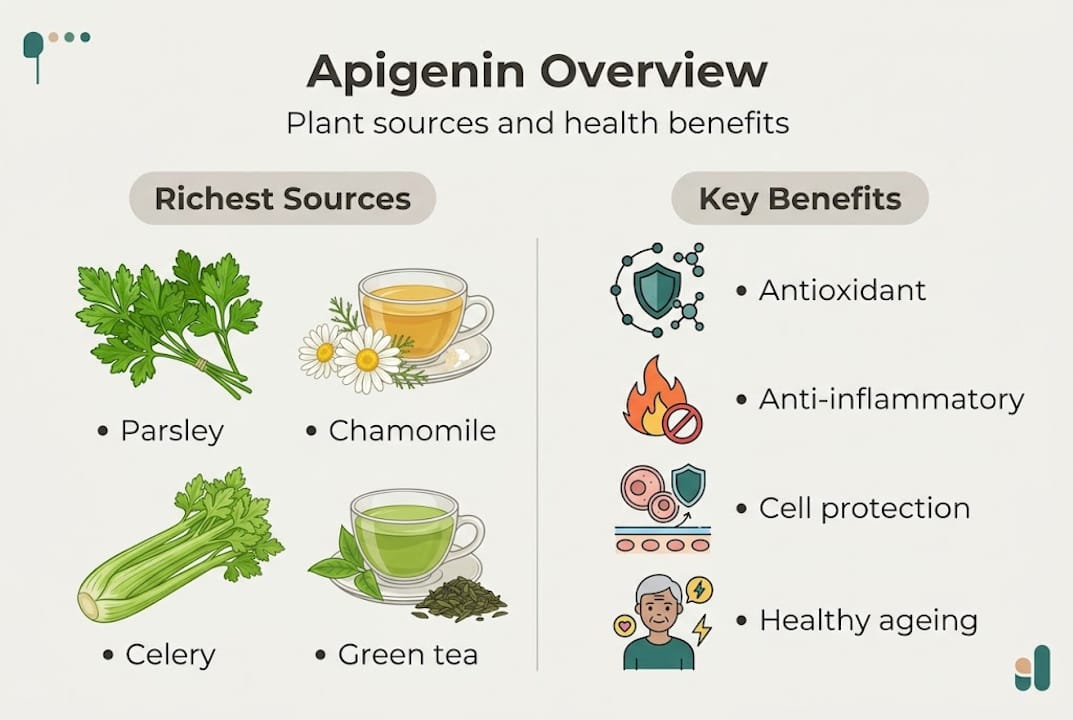
L’apigénine se trouve dans les fruits, légumes et herbes, notamment le céleri, le persil, la camomille et le thé vert. Le persil se distingue comme l’une des sources les plus concentrées, tandis que la tisane de camomille est un moyen de consommation largement répandu pour ce composé. Le tableau ci-dessous offre un aperçu pratique des sources alimentaires courantes.
| Aliment ou herbe | Contenu approximatif en apigénine pour 100 g |
|---|---|
| Persil séché | 13 000 mg |
| Persil frais | 215 mg |
| Camomille (séchée) | 3 000 à 5 000 mg |
| Céleri (cru) | 19 mg |
| Thé vert (feuilles séchées) | 10 à 20 mg |
| Oranges | 2 à 5 mg |
La source importe considérablement quand on pense à l'absorption et au dosage pratique. Voici pourquoi :
- Formes glycosides vs aglycones : Dans les aliments, l'apigénine est souvent liée à des molécules de sucre (glycosides). Le corps doit d'abord cliver ces liaisons avant d'absorber le composé actif, ce qui affecte la quantité qui atteint la circulation sanguine.
- Effets de la matrice alimentaire : Les fibres, les graisses et d'autres composés dans les aliments entiers modifient la vitesse et l'étendue de l'absorption par rapport aux compléments isolés.
- Variabilité de concentration : Les conditions de culture, le traitement et le stockage influencent les niveaux d'apigénine dans les aliments, rendant l'apport alimentaire incohérent.
- Standardisation des compléments : Un complément d'apigénine de qualité fournit une dose standardisée, éliminant les approximations liées aux seules sources alimentaires.
Comprendre d'où vient l'apigénine prépare le terrain pour évaluer ce qu'elle peut réellement faire pour votre santé.
Que fait l'apigénine ? Effets sur la santé et potentiel de longévité
L'apigénine agit simultanément sur plusieurs voies biologiques. Elle active Nrf2, un régulateur principal de la défense antioxydante, ce qui incite les cellules à produire leurs propres enzymes protectrices. Elle supprime également NF-kB, un moteur clé de la signalisation inflammatoire. En termes pratiques, cela signifie que l'apigénine agit sur deux fronts : réduire les espèces réactives de l'oxygène (ROS) qui endommagent les cellules, et calmer l'inflammation chronique de bas grade qui accélère le vieillissement.
L'apigénine démontre des effets anti-inflammatoires, antioxydants, anticancéreux, antidiabétiques, neuroprotecteurs et cardioprotecteurs via plusieurs voies cellulaires. Ce ne sont pas des observations isolées. Elles apparaissent dans des études cellulaires, des modèles animaux et un nombre croissant d'investigations humaines.
Un mécanisme particulièrement pertinent pour un vieillissement en bonne santé est son action sénomorphique. Les cellules sénescentes sont des cellules âgées et dysfonctionnelles qui refusent de mourir et libèrent à la place des signaux inflammatoires. L'apigénine n'élimine pas nécessairement ces cellules, mais elle peut moduler leur comportement.
L'action sénomorphique de l'apigénine ralentit l'inflammation liée à l'âge, parfois appelée « inflammaging », en réduisant les signaux nocifs que les cellules sénescentes libèrent dans les tissus environnants. Cela en fait un composé d'un intérêt réel dans la recherche sur la longévité. En savoir plus sur les mécanismes de la sénescence et comment l'apigénine s'inscrit dans ce contexte.
La distinction entre preuves précliniques et cliniques est importante ici. Le tableau ci-dessous clarifie où en est actuellement la science.
| Type de preuve | Ce que cela montre | Niveau de confiance |
|---|---|---|
| Études cellulaires (in vitro) | Effets anti-inflammatoires et antioxydants forts | Modéré (pas directement applicable aux humains) |
| Études animales (in vivo) | Neuroprotection, réduction de la croissance tumorale, amélioration des marqueurs métaboliques | Modéré (des différences entre espèces s'appliquent) |
| Essais humains (cliniques) | Quelques signaux anti-inflammatoires et antioxydants | Faible (peu d'ERC robustes disponibles) |
Les preuves humaines anti-âge sont prometteuses mais non concluantes en raison du manque d'essais randomisés contrôlés à grande échelle. Ce n'est pas une raison pour écarter l'apigénine. C'est une raison d'aborder son usage avec des attentes calibrées.
Les effets clés soutenus par les recherches actuelles incluent :
- Réduction des marqueurs d'inflammation chronique
- Diminution du stress oxydatif au niveau cellulaire
- Effets neuroprotecteurs pertinents pour la santé cognitive
- Soutien potentiel à la fonction métabolique
- Modulation de l'activité des cellules sénescentes
Astuce : Associez les aliments ou compléments riches en apigénine avec d'autres antioxydants tels que la quercétine ou le resvératrol. Découvrez les meilleurs antioxydants pour le vieillissement pour comprendre comment ces composés peuvent agir ensemble. Combiner les flavonoïdes peut produire des effets additifs sur les voies inflammatoires, ce qui est une stratégie pratique soutenue par la recherche nutritionnelle.
Pour une vue plus large de la place de l'apigénine dans une stratégie de supplémentation axée sur la longévité, le guide des suppléments fondés sur des preuves fournit un contexte utile.
Absorption, biodisponibilité et pourquoi la formulation est importante
La biodisponibilité fait référence à la proportion d'une substance qui entre en circulation et atteint ses tissus cibles après ingestion. Pour l'apigénine, c'est une préoccupation pratique importante. Une faible biodisponibilité orale due à une faible solubilité et un métabolisme rapide signifie qu'une partie importante d'une dose standard peut ne jamais atteindre les cellules où elle est nécessaire. La nanoformulation et d'autres stratégies de délivrance peuvent améliorer significativement l'absorption.

Dans les aliments, l'apigénine existe généralement sous forme de glycoside, c’est-à-dire attachée à une molécule de sucre. L'intestin doit convertir cela en apigénine libre (forme aglycone) avant que l'absorption puisse avoir lieu. Les fabricants de compléments utilisent directement la forme aglycone libre, ce qui évite cette étape de conversion. Cependant, même sous forme aglycone, l'apigénine fait face à des défis : elle est peu soluble dans l'eau et rapidement métabolisée par les enzymes hépatiques.
Les stratégies modernes de formulation répondent à ces limitations par plusieurs approches :
- Délivrance par nanoparticules : Réduit la taille des particules pour augmenter la surface et la solubilité, améliorant ainsi l'absorption à travers la paroi intestinale.
- Encapsulation liposomale : Enrobe l'apigénine dans une coque lipidique, la protégeant du métabolisme précoce et améliorant sa délivrance cellulaire.
- Complexes phospholipidiques : Combinent l'apigénine avec de la phosphatidylcholine pour améliorer la solubilité dans les graisses et l'absorption.
- Formules combinées : Associent l'apigénine à la pipérine ou à d'autres agents améliorant la biodisponibilité qui ralentissent la dégradation métabolique.
Pour choisir un complément, suivez ces trois étapes :
- Contrôlez le type de formulation. Recherchez des produits qui spécifient une nanoformulation, une délivrance liposomale ou des complexes phospholipidiques sur l'étiquette. Les capsules en poudre standard peuvent offrir une biodisponibilité moindre.
- Vérifiez le dosage. Les doses efficaces étudiées se situent généralement entre 50 et 200 mg par prise. Les produits en dehors de cette plage sans justification clinique méritent une attention particulière.
- Vérifiez les tests tiers. Les fabricants réputés fournissent des certificats d'analyse confirmant la pureté et la puissance. Cela est particulièrement important pour un composé dont la concentration varie largement.
Astuce pro : Prenez votre complément d'apigénine avec un repas contenant des graisses saines, comme de l'avocat, de l'huile d'olive ou des noix. Les graisses améliorent l'absorption des composés liposolubles, et la captation de l'apigénine s'améliore nettement en présence de lipides alimentaires. Une formulation améliorée d'apigénine provenant d'un fournisseur de qualité prend déjà en compte bon nombre de ces défis de biodisponibilité.
Sécurité, dosage et ce qu'il faut savoir avant de prendre un complément
L'apigénine présente un profil de sécurité rassurant selon les données disponibles. Les études actuelles montrent une toxicité généralement faible et une bonne sécurité, avec une légère sédation observée à fortes doses. Les interactions médicamenteuses potentielles restent mal caractérisées, bien que l'apigénine soit bien tolérée en contexte préclinique et clinique. C'est une base significative, mais cela ne signifie pas que l'apigénine est sans risque pour tout le monde.
La plage typique de supplémentation étudiée dans la recherche se situe entre 50 mg et 200 mg par jour. La plupart des produits commercialisés se situent dans cette fourchette. Des doses plus élevées n'ont pas démontré de bénéfices proportionnellement plus importants dans les études humaines, et l'effet sédatif observé à des doses élevées suggère qu'il existe un plafond pratique à respecter.
Les effets secondaires rapportés dans les études incluent :
- Légère somnolence ou sédation, particulièrement à des doses supérieures à 200 mg
- Effets hormonaux possibles à très fortes doses (l'apigénine interagit avec les récepteurs œstrogéniques)
- Inconfort gastro-intestinal chez les personnes sensibles
- Potentiel d'effets renforcés des médicaments sédatifs
Le tableau des interactions est encore incomplet. L'apigénine inhibe certaines enzymes cytochrome P450 dans le foie, responsables du métabolisme de nombreux médicaments pharmaceutiques. Cela signifie qu'elle pourrait théoriquement augmenter ou diminuer les niveaux sanguins de médicaments traités par la même voie. Jusqu'à ce que davantage de données existent, la prudence est de mise.
Les groupes suivants devraient consulter un professionnel de santé avant de commencer l'apigénine :
- Les personnes enceintes ou allaitantes
- Ceux prenant des médicaments anticoagulants (par exemple la warfarine)
- Les individus sous sédatifs, anxiolytiques ou médicaments pour le sommeil
- Les personnes atteintes de conditions sensibles aux hormones
- Les personnes sous immunosuppresseurs ou agents chimiothérapeutiques
Pour les adultes en bonne santé sans les considérations ci-dessus, l'apigénine à des doses standard semble être un ajout à faible risque dans une routine de compléments bien structurée. Commencez toujours par le bas de la fourchette de dosage et évaluez votre réponse individuelle avant d'augmenter.
Pourquoi la plupart des gens comprennent mal le potentiel de l'apigénine
L'industrie des compléments tend à simplifier les nuances. Un composé montre des promesses dans des études cellulaires, et en quelques mois, il est commercialisé comme une avancée en matière de longévité. L'apigénine n'échappe pas à ce schéma. La position honnête est que les preuves humaines sont en retard par rapport aux promesses précliniques, et bien que les formulations améliorées aident à combler le déficit de biodisponibilité, une alimentation constamment riche en flavonoïdes naturels reste la base la plus fiable.
Ce que cela signifie concrètement : une capsule prise isolément, sans attention à l'alimentation, au sommeil et à la charge inflammatoire, est peu susceptible de produire des résultats significatifs. L'apigénine fonctionne mieux dans le cadre d'une stratégie plus large. Associez-la à une alimentation variée et riche en plantes, gérez le stress chronique et privilégiez la qualité du sommeil. Ces habitudes amplifient l'environnement cellulaire dans lequel l'apigénine agit.
Astuce pro : Suivez votre apport en flavonoïdes alimentaires pendant une semaine avant d’ajouter un complément. Vous constaterez peut-être que de simples ajustements alimentaires, comme ajouter du persil frais aux repas ou boire régulièrement de la tisane de camomille, fournissent une base significative avant même de recourir à une capsule.
La trajectoire de la recherche est encourageante. Les essais en cours commencent à combler le manque de données humaines. Pour l’instant, la position la plus informée est celle d’un optimisme prudent, soutenu par des choix de compléments basés sur des preuves et des attentes réalistes quant à ce qu’un seul composé peut accomplir.
Étapes suivantes : vitalité appuyée par la science avec Vivetus®
Si vous êtes prêt à agir sur les preuves, Vivetus® propose des formulations conçues avec la biodisponibilité et la pureté à l’esprit. L’objectif n’est pas de vous vendre un complément pour chaque problème, mais de fournir des options fondées sur les mêmes standards scientifiques que cet article a exposés.

Découvrez la gamme de soutien santé à l’apigénine pour des options autonomes, ou considérez le pack énergie et vitalité si vous construisez une routine de vieillissement sain plus large. La livraison gratuite pour les commandes de plus de 50 € facilite le démarrage sans coût inutile. Utilisez le blog Vivetus® et les pages produits comme points de référence pour approfondir la lecture à mesure que la science sur l’apigénine évolue.
Questions fréquemment posées
Quel aliment contient le plus d’apigénine ?
Le persil et la camomille font partie des sources naturelles les plus riches en apigénine, le persil séché contenant des concentrations particulièrement élevées pour 100 g.
Puis-je utiliser l’apigénine en toute sécurité chaque jour ?
Une utilisation quotidienne de 50 à 200 mg semble sûre selon les preuves actuelles, mais consultez un professionnel de santé si vous prenez des médicaments réguliers ou avez des conditions médicales sous-jacentes.
L’apigénine est-elle un véritable complément anti-âge ?
L’apigénine montre de véritables effets anti-inflammatoires et modulant la sénescence, mais les essais cliniques randomisés robustes chez l’humain restent limités, il est donc préférable de la considérer comme un composé de soutien prometteur plutôt qu’une solution anti-âge confirmée.
Qu’est-ce qui améliore l’absorption des compléments d’apigénine ?
Choisir un complément nanoformulé et le prendre avec un repas contenant des graisses sont les deux étapes les plus pratiques pour améliorer la quantité d’apigénine réellement absorbée par votre corps.