

Les bienfaits du vieillissement en bonne santé : les 10 principaux avantages prouvés
En résumé :
- Le vieillissement en bonne santé vise à prolonger la durée de vie en bonne santé en réduisant les maladies chroniques et en maintenant l'indépendance grâce à des choix de mode de vie. L'activité physique régulière, l'entraînement à l'équilibre, une nutrition riche en nutriments, la stimulation mentale et les mesures de prévention de la santé soutiennent de manière synergique la longévité et la qualité de vie. La combinaison de ces habitudes se renforce mutuellement, faisant des étapes progressives et constantes l'approche la plus efficace pour bien vieillir.
Le vieillissement en bonne santé se définit comme l'extension de votre durée de vie en bonne santé — les années vécues sans maladie invalidante ni limitations sérieuses — plutôt que simplement ajouter des années à votre vie. Harvard Health établit une distinction claire entre la durée de vie et la durée de vie en bonne santé, notant que les choix de mode de vie influencent directement les maladies chroniques les plus susceptibles de réduire la vie active, notamment les maladies cardiaques, les AVC, le diabète et la démence. Les bienfaits du vieillissement en bonne santé ne sont pas abstraits. Ils se manifestent dans votre capacité à aller faire des courses, à vous souvenir de l'anniversaire d'un ami ou à vivre de manière autonome à 80 ans. La bonne nouvelle est que l'activité physique, la nutrition, l'entraînement à l'équilibre, la connexion sociale et l'engagement mental contribuent chacun de manière mesurable à ce résultat.
1. Quels sont les principaux bienfaits physiques de rester actif ?
L'activité physique régulière est la stratégie la mieux étayée pour promouvoir la longévité et maintenir les fonctions avec l'âge. Stanford Medicine cite des recherches montrant que 7 000 pas par jour réduisent significativement la mortalité et le risque de maladies cardiovasculaires chez les personnes âgées. Ce chiffre est atteignable pour la plupart des gens et ne nécessite pas d'abonnement à une salle de sport ni de pratique sportive structurée.
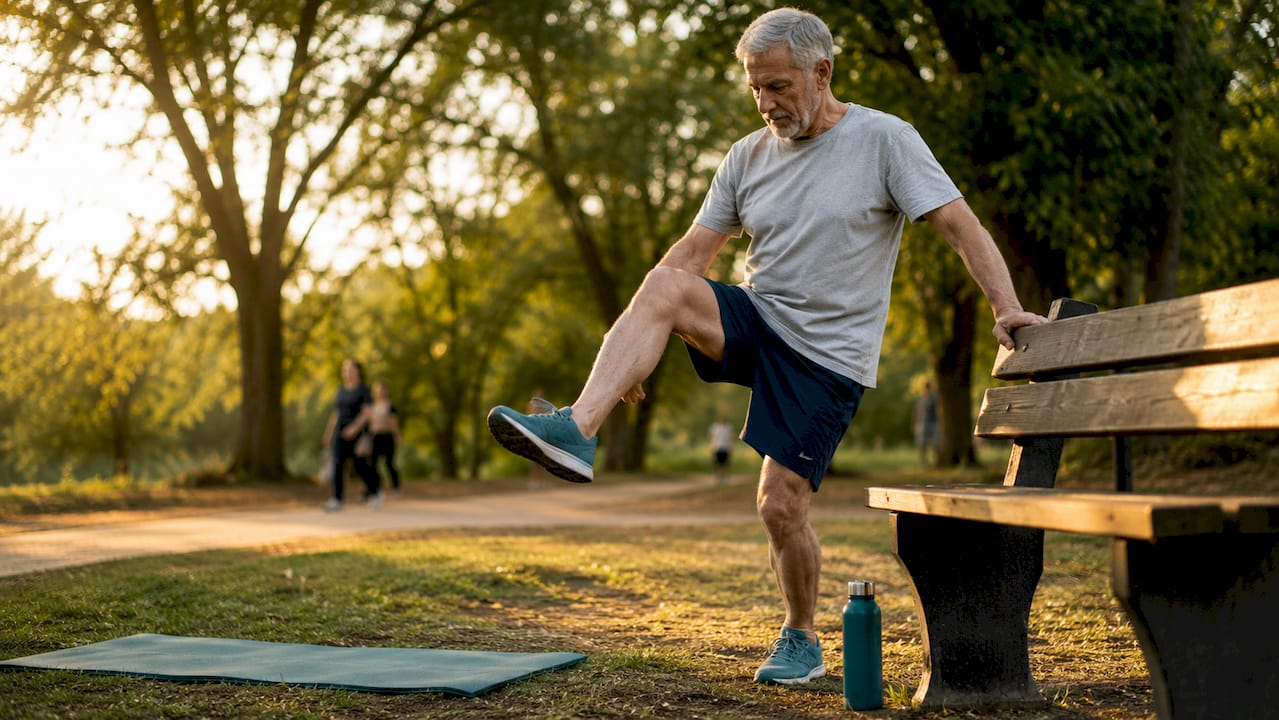
Les bienfaits d'un mode de vie actif vont bien au-delà du cœur. L'exercice aérobie améliore la capacité pulmonaire, réduit la pression artérielle et diminue la glycémie à jeun. L'entraînement en force préserve la masse musculaire et prévient la sarcopénie, la perte musculaire liée à l'âge qui rend les tâches quotidiennes de plus en plus difficiles. Ensemble, ces adaptations signifient que vous maintenez les réserves physiques nécessaires pour vivre de manière autonome.
Une découverte qui surprend beaucoup de gens : diviser les promenades en séances de 10 minutes procure les mêmes bienfaits cardiovasculaires et sur la mortalité qu'une seule séance plus longue. Stanford Medicine note que de nombreux adultes plus âgés sous-dosent l'exercice en ne faisant qu'un seul bloc d'activité par jour. Trois courtes promenades réparties dans la matinée, l'après-midi et le soir peuvent être plus pratiques et tout aussi efficaces.
- Visez au moins 7 000 pas par jour, répartis en plusieurs courtes marches si nécessaire
- Incluez deux séances d’activités de renforcement musculaire par semaine pour contrer la sarcopénie
- Combinez exercices aérobiques et de résistance pour réduire les risques de maladies cardiaques, d’AVC et de diabète de type 2
- Suivez vos mouvements quotidiens avec un podomètre ou un smartphone pour maintenir la régularité
Astuce : Associez une marche de 10 minutes après chaque repas principal. Cette habitude seule peut représenter 3 000 pas ou plus par jour et aide à réguler la glycémie après le repas.
2. Comment l’entraînement à l’équilibre réduit les chutes et protège l’autonomie
Les chutes sont la principale cause de blessures et de perte d’autonomie chez les personnes âgées. La capacité à tenir en appui sur une jambe pendant 10 secondes est directement liée à une amélioration des taux de mortalité, ce qui en fait l’un des tests fonctionnels les plus pratiques. Si vous ne pouvez pas tenir cette position, l’entraînement ciblé de l’équilibre devient une priorité.
Les années 60 et 70 sont la période idéale pour renforcer l’équilibre et la stabilité de la démarche avant que les déficits ne deviennent graves. Attendre une chute pour agir est une erreur fréquente et coûteuse. L’entraînement à l’équilibre ne nécessite pas d’équipement spécialisé. Un appui dans un angle, où vous faites face à un coin en touchant légèrement chaque mur avec les mains, ou un simple appui sur une jambe pratiqué quotidiennement, produit des améliorations mesurables en quelques semaines.
La méthode la plus efficace est d’associer les exercices d’équilibre aux habitudes quotidiennes existantes. Tenez-vous sur une jambe en vous brossant les dents. Maintenez un appui dans un angle pendant 30 secondes avant de préparer votre café du matin. Ces micro-sessions s’accumulent rapidement et éliminent la nécessité de consacrer un temps spécifique à l’exercice.
- Testez votre équilibre maintenant : tenez-vous près d’un mur et essayez de rester en appui sur une jambe pendant 10 secondes
- Pratiquez quotidiennement des appuis dans un angle, en tenant 20 à 30 secondes par série
- Progressez en vous tenant debout sur une serviette pliée ou un coussin pour augmenter la difficulté
- Ajoutez la marche talon-pointe dans un couloir pour améliorer la stabilité de la démarche
- Associez le travail d’équilibre à des exercices de renforcement du bas du corps comme des répétitions assis-debout
Astuce : Programmez un rappel téléphonique intitulé « minute d’équilibre » deux fois par jour. La régularité sur deux semaines produit des améliorations notables en stabilité et en confiance.
3. Stratégies nutritionnelles pour bien vieillir
La nutrition pour les personnes âgées suit un principe que beaucoup trouvent contre-intuitif : les besoins caloriques diminuent avec l’âge, mais les besoins en nutriments restent les mêmes ou augmentent. Le NIDDK précise que les aliments riches en nutriments sont indispensables pour les personnes âgées, précisément parce qu’il y a moins de marge calorique pour des choix nutritionnels vides. Chaque repas prend plus d’importance.
L'apport en protéines mérite une attention particulière. Un apport protéique adéquat, provenant de sources telles que les œufs, les légumineuses, le poisson et la viande maigre, soutient directement le maintien musculaire et ralentit la sarcopénie. Les céréales complètes, les fruits et légumes fournissent des fibres, des antioxydants et des micronutriments qui réduisent l'inflammation systémique, un facteur de maladies cardiaques, de certains cancers et du déclin cognitif. Les graisses saines provenant de sources telles que l'huile d'olive, les poissons gras et les noix soutiennent simultanément la santé cardiovasculaire et cérébrale.
L'hydratation est un facteur moins discuté mais important. Le mécanisme de la soif s'affaiblit avec l'âge, ce qui signifie que les personnes âgées peuvent se déshydrater sans ressentir la soif. Une déshydratation chronique légère altère la concentration, augmente le risque de chutes et sollicite la fonction rénale. Boire de l'eau régulièrement tout au long de la journée, plutôt que d'attendre d'avoir soif, est un conseil pratique et peu coûteux pour bien vieillir.
| Priorité alimentaire | Pourquoi c'est important pour le vieillissement |
|---|---|
| Protéines de haute qualité | Préserve la masse musculaire et ralentit la sarcopénie |
| Céréales complètes et fibres | Réduit le risque de maladies cardiovasculaires et métaboliques |
| Fruits et légumes | Fournit des antioxydants qui combattent l'inflammation |
| Graisses saines (huile d'olive, poissons gras) | Soutient la fonction cardiaque et cérébrale |
| Hydratation constante | Protège la cognition, la fonction rénale et l'équilibre |
Pour des conseils pratiques sur la composition d'une assiette répondant à ces priorités, le guide régime équilibré pour les personnes âgées de Vivetus détaille les besoins caloriques et nutritionnels.
- Limitez les sucres ajoutés, les aliments transformés et l'excès de sel, qui remplacent les options riches en nutriments
- Choisissez des aliments enrichis ou des compléments ciblés en cas de carences alimentaires, en particulier pour la vitamine D et la B12
- Prenez des repas réguliers plutôt que de sauter des repas, pour maintenir une énergie stable et la synthèse des protéines musculaires
4. Engagement mental et social pour la santé cérébrale
Les personnes physiquement actives sont moins susceptibles de développer une démence et ont tendance à conserver une cognition plus aiguisée à un âge avancé. Harvard Health identifie à la fois l'exercice et la stimulation mentale comme des facteurs protecteurs contre le déclin cognitif. Le mécanisme n'est pas mystérieux : le cerveau réagit au défi et à la nouveauté en formant de nouvelles connexions neuronales, un processus qui se poursuit bien au-delà de la vieillesse.
L'engagement mental prend de nombreuses formes. Lire, faire des mots croisés ou des Sudoku, apprendre un instrument de musique, étudier une nouvelle langue ou suivre un cours en ligne offrent tous le défi cognitif qui soutient la santé cérébrale. L'essentiel est la nouveauté et l'effort soutenu. Les activités passives comme regarder la télévision ne produisent pas le même bénéfice.
La connexion sociale amplifie ces bénéfices. Des liens sociaux solides sont associés à une vie plus longue, à des taux de dépression plus faibles et à une mémoire plus vive. L'isolement, en revanche, accélère le déclin cognitif à un rythme comparable à celui du tabagisme. Un contact régulier avec des amis, la famille ou des groupes communautaires, que ce soit en personne ou par appel vidéo, n'est pas un luxe. C'est un comportement de santé fonctionnel.
- Pratiquez des activités mentalement stimulantes au moins 30 minutes par jour
- Priorisez le contact social en face à face lorsque c'est possible, complété par la communication numérique
- Gérez le stress chronique par des pratiques telles que la pleine conscience, la marche ou la respiration structurée, car une élévation prolongée du cortisol endommage l'hippocampe
- Protégez la qualité du sommeil : sept à huit heures par nuit favorisent la consolidation de la mémoire et la régulation émotionnelle
5. Mesures de santé préventive qui prolongent votre durée de vie en bonne santé
Les soins préventifs et les choix de mode de vie travaillent ensemble pour retarder ou éviter les maladies chroniques qui raccourcissent la durée de vie en bonne santé. Harvard Health conseille de suivre les tests de dépistage recommandés pour la tension artérielle, le cholestérol, la glycémie et les dépistages du cancer pertinents. Détecter ces marqueurs tôt signifie que l'intervention est plus simple, moins invasive et plus efficace.
La gestion des facteurs de risque modifiables est là où le mode de vie et la médecine préventive se recoupent le plus clairement. Réduire la graisse abdominale diminue le risque d'infarctus et d'accident vasculaire cérébral plus que la simple perte de poids globale, car la graisse viscérale est métaboliquement active et pro-inflammatoire. Maintenir la tension artérielle et le cholestérol dans des plages saines grâce à l'alimentation, à l'exercice et, si nécessaire, à un soutien médical, réduit directement la probabilité d'événements cardiovasculaires.
Éviter le tabac et limiter la consommation d'alcool restent deux des décisions de mode de vie les plus impactantes. Les deux sont des facteurs bien établis de cancer, de maladies cardiovasculaires et de déclin cognitif accéléré. La qualité du sommeil et la gestion du stress complètent ce tableau. Un sommeil chroniquement de mauvaise qualité augmente la tension artérielle, altère le métabolisme du glucose et accroît les marqueurs inflammatoires, ce qui réduit la durée de vie en bonne santé.
| Facteur de mode de vie | Impact sur la durée de vie en bonne santé |
|---|---|
| Dépistages préventifs réguliers | Permet une intervention précoce avant que les conditions ne deviennent invalidantes |
| Maintenir un poids abdominal sain | Réduit directement le risque de maladies cardiovasculaires et métaboliques |
| Ne pas fumer | Réduit considérablement le risque de cancer, d'accident vasculaire cérébral et de maladies pulmonaires |
| Limiter l'alcool | Réduit le risque de maladies du foie, de cancer et de déclin cognitif |
| Sommeil de qualité (7 à 8 heures) | Soutient la santé métabolique, cardiovasculaire et cérébrale |
6. Résilience émotionnelle et bien-être psychologique
Le bien-être psychologique est une composante mesurable du vieillissement en bonne santé, pas un simple ajout accessoire. Les personnes âgées qui déclarent un fort sentiment de but affichent des taux plus faibles de maladies cardiovasculaires, une meilleure fonction immunitaire et une vie plus longue. Le but ne nécessite pas une grande ambition. Le bénévolat, le mentorat, les projets créatifs ou le soin constant des autres fournissent tous la structure et le sens qui soutiennent la résilience émotionnelle.
L'anxiété et la dépression sont courantes mais pas inévitables à un âge avancé. Ces deux conditions sont traitables et répondent bien aux mêmes facteurs de mode de vie abordés tout au long de cet article : exercice, lien social, sommeil et engagement mental. Reconnaître que la santé émotionnelle est aussi modifiable que la santé physique représente un changement important pour de nombreux seniors.
Les pratiques de gratitude et le journal réflexif disposent d'une base de preuves modeste mais constante pour améliorer l'humeur et réduire l'anxiété. Elles ne nécessitent aucun équipement et peu de temps. Cinq minutes de réflexion structurée chaque matin ou soir peuvent détourner l'attention de la rumination vers ce qui fonctionne bien.
7. L'effet cumulatif de la combinaison de plusieurs habitudes saines
Les avantages d'un bon vieillissement se multiplient lorsque les stratégies de mode de vie sont combinées plutôt que poursuivies isolément. Une personne qui fait régulièrement de l'exercice, suit un régime riche en nutriments, maintient des liens sociaux et participe à des dépistages préventifs ne fait pas que cumuler les bénéfices individuels. Les effets se composent. L'exercice améliore la qualité du sommeil, ce qui améliore l'humeur, ce qui augmente la motivation à socialiser, ce qui protège davantage la cognition.
Les recherches de Stanford Medicine sur le vieillissement en bonne santé dans les années 60 et 70 soulignent constamment cet effet d'interaction. Aucun seul comportement n'est suffisant en soi, mais chacun facilite le maintien des autres. C'est pourquoi présenter le vieillissement en bonne santé comme une liste de tâches séparées manque le point essentiel. L'objectif est de construire un mode de vie où ces comportements se renforcent mutuellement.
Commencer par un ou deux changements et progresser graduellement est plus efficace que de tenter une refonte complète. Choisir une marche quotidienne de 10 minutes et une portion supplémentaire de légumes par jour crée une base. L'entraînement de l'équilibre et l'engagement social peuvent être ajoutés au cours des semaines suivantes. La synergie commence immédiatement.
Points clés
L'approche la plus efficace pour un vieillissement en bonne santé combine activité physique, nutrition dense en nutriments, entraînement de l'équilibre, stimulation mentale et soins préventifs dans un mode de vie qui se renforce mutuellement plutôt que de traiter chaque habitude séparément.
| Point | Détails |
|---|---|
| Durée de vie en bonne santé plutôt que durée de vie totale | L'objectif est plus d'années sans maladie invalidante, pas simplement plus d'années. |
| L'activité physique est fondamentale | 7 000 pas quotidiens, répartis en courtes sessions, réduisent le risque cardiovasculaire et de mortalité. |
| L'entraînement de l'équilibre prévient les chutes | Le maintien sur une jambe pendant 10 secondes prédit le risque de mortalité et oriente un entraînement ciblé. |
| La densité nutritionnelle compte plus que les calories | Les personnes âgées ont besoin de moins de calories mais d'un apport en nutriments égal ou supérieur. |
| Les habitudes se renforcent lorsqu'elles sont combinées | L'exercice, le sommeil, la nutrition et l'engagement social se renforcent mutuellement. |
Ce que j'ai appris en me concentrant sur la durée de vie en bonne santé
J'ai passé beaucoup de temps à examiner les preuves sur le bien vieillir, et la constatation qui ressort constamment est à quel point la plupart des gens mal cadrent l'objectif. La conversation tend à se focaliser sur la longévité. Combien de temps vais-je vivre ? C'est la mauvaise question. La bonne question est : combien de ces années vais-je passer à faire ce que je veux, sans limitation physique ou cognitive significative ?
Les recherches de Harvard Health et Stanford Medicine vont dans le même sens. Les conditions qui réduisent le plus sûrement la durée de vie en bonne santé, notamment les maladies cardiaques, le diabète de type 2, la démence et les blessures liées aux chutes, sont largement modifiables par le mode de vie. Ce n'est pas une simple note en bas de page. Cela signifie que la majorité de ce qui détermine votre qualité de vie dans la soixantaine et la vieillesse est sous votre influence dès maintenant.
Ce que je trouve sous-estimé, c'est l'entraînement de l'équilibre. La plupart des gens se concentrent sur la forme cardiovasculaire ou la gestion du poids et considèrent l'équilibre comme quelque chose qui décline passivement avec l'âge. Ce n'est pas une fatalité. Le test de maintien sur une jambe est une auto-évaluation vraiment utile. Si vous ne pouvez pas tenir 10 secondes, c'est une information précise et traitable. Agissez en conséquence.
L'autre chose qu'il vaut la peine de dire clairement : de petits pas constants surpassent à chaque fois des efforts intenses occasionnels. Une marche de 10 minutes après le dîner, une poignée de noix à la place d'un biscuit, un appel téléphonique à un ami chaque semaine. Ce ne sont pas des interventions spectaculaires. C'est le mécanisme réel par lequel la durée de vie en bonne santé se construit.
— Jord
Comment Vivetus soutient vos objectifs de vieillissement en santé
Vivetus réunit des produits nutritionnels basés sur des preuves et des conseils pratiques de mode de vie conçus spécifiquement pour les personnes âgées, axés sur la vitalité et l’indépendance. Que vous cherchiez à combler des carences, soutenir le maintien musculaire ou trouver des compléments ciblés pour la santé cognitive et cardiovasculaire, le catalogue Vivetus s’appuie sur la science présentée dans cet article. Explorez le guide des compléments nutritionnels pour un aperçu structuré des options prouvées, ou parcourez la gamme complète Vivetus pour un vieillissement en santé afin de trouver des produits adaptés à vos objectifs spécifiques. La livraison est gratuite pour les commandes de plus de 50 €.
FAQ
Quelle est la différence entre durée de vie et durée de vie en bonne santé ?
La durée de vie est le nombre total d’années vécues. La durée de vie en bonne santé est la période passée sans maladie invalidante ni limitation physique ou cognitive grave. Harvard Health identifie la durée de vie en bonne santé comme la mesure la plus significative d’un bon vieillissement.
Combien de pas par jour favorisent un vieillissement en santé ?
Stanford Medicine recommande 7 000 pas par jour comme objectif réduisant significativement la mortalité et le risque de maladies cardiovasculaires. Ces pas peuvent être accumulés lors de plusieurs courtes marches d’au moins 10 minutes chacune.
Pourquoi l’entraînement à l’équilibre est-il important pour les personnes âgées ?
Les chutes sont la principale cause de blessures et de perte d’autonomie chez les personnes âgées. Des recherches citées par Stanford Medicine montrent que la capacité à tenir en équilibre sur une jambe pendant 10 secondes est corrélée à une meilleure survie, faisant de l’entraînement à l’équilibre une stratégie directe de longévité.
Les besoins nutritionnels changent-ils avec l’âge ?
Les besoins caloriques diminuent avec l’âge, mais les besoins en nutriments restent les mêmes ou augmentent. Le NIDDK recommande de privilégier les aliments complets riches en nutriments, un apport adéquat en protéines et une hydratation constante pour répondre à ces besoins avec un apport calorique réduit.
L’activité mentale peut-elle réduire le risque de démence ?
Harvard Health identifie la stimulation mentale régulière et l’activité physique comme des facteurs protecteurs contre le déclin cognitif et la démence. Les activités impliquant nouveauté et effort soutenu, comme apprendre une nouvelle compétence ou un instrument, produisent le bénéfice le plus fort.