

Comment l'alimentation influence un vieillissement sain et la vitalité après 40 ans
Beaucoup croient que le vieillissement entraîne inévitablement une baisse d'énergie et de santé, pourtant des recherches récentes révèlent que l'alimentation joue un rôle étonnamment puissant dans la manière dont nous vieillissons avec grâce. Les aliments que vous choisissez chaque jour influencent la réparation cellulaire, les niveaux d'inflammation et même l'expression génétique liée à la longévité. Plutôt que d'accepter la fatigue et la diminution de vitalité comme inévitables, comprendre l'impact de la nutrition sur les processus de vieillissement vous permet de reprendre le contrôle. Cet article explore comment l'alimentation affecte les mécanismes biologiques du vieillissement, quels régimes alimentaires favorisent la longévité, et des stratégies pratiques incluant des compléments pour maintenir énergie et vitalité bien au-delà de la quarantaine.
Table des matières
- Points clés
- Comment l'alimentation influence les processus biologiques du vieillissement
- Régimes alimentaires liés à la longévité et à la vitalité
- Stratégies pratiques d'alimentation et de supplémentation pour la vitalité après 40 ans
- Comparaison des compléments populaires qui soutiennent un vieillissement sain
- Découvrez des compléments pour un vieillissement sain et la vitalité
- Questions fréquemment posées
Points clés
| Point | Détails |
|---|---|
| La méthylation contrôle les gènes | La méthylation influence l'activation ou la mise en silence des gènes liés au vieillissement via l'alimentation. |
| Les antioxydants limitent les dommages liés au vieillissement | Les antioxydants issus de fruits et légumes colorés aident à neutraliser les radicaux libres et à limiter les dommages cellulaires. |
| Aliments anti-inflammatoires | Les acides gras oméga-3 et les fibres aident à réduire l'inflammation chronique liée au vieillissement. |
| L'équilibre calorique favorise la longévité | Un équilibre calorique modéré et des aliments riches en nutriments soutiennent l'énergie et les processus de vieillissement. |
Comment l'alimentation influence les processus biologiques du vieillissement
Vos choix alimentaires façonnent le vieillissement au niveau moléculaire par plusieurs mécanismes interconnectés. Les nutriments influencent l'expression génétique via la méthylation, un processus biochimique où des groupes méthyle se fixent à l'ADN, régulant l'activation ou la mise en silence des gènes. L'alimentation impacte la méthylation et les niveaux d'homocystéine influençant les processus de vieillissement, notamment grâce à des nutriments comme la bétaïne qui soutiennent cette voie critique. Un équilibre approprié de la méthylation affecte la santé cardiovasculaire, la fonction cognitive et la réparation cellulaire tout au long de la vie.
Le stress oxydatif représente une autre voie clé où l'alimentation croise le vieillissement. Les radicaux libres générés lors du métabolisme normal endommagent les composants cellulaires, y compris l'ADN, les protéines et les lipides. Les antioxydants alimentaires issus de fruits, légumes, noix et graines colorés neutralisent ces molécules réactives, réduisant les dommages cumulatifs qui accélèrent les signes visibles et internes du vieillissement. Les vitamines C et E, les polyphénols et les caroténoïdes offrent cet effet protecteur lorsqu'ils sont consommés régulièrement via des aliments complets.
L’inflammation relie l’alimentation au développement des maladies liées à l’âge. L’inflammation chronique de bas grade, souvent appelée inflammaging, contribue à des affections comme les maladies cardiovasculaires, le diabète et le déclin cognitif. Certains aliments favorisent l’inflammation tandis que d’autres la suppriment. Les aliments transformés riches en sucres raffinés et en gras trans déclenchent des réponses inflammatoires, tandis que les acides gras oméga-3, les fibres et les phytonutriments réduisent de manière mesurable les marqueurs inflammatoires.
L’apport calorique lui-même affecte les voies du vieillissement au-delà de la simple gestion du poids. Une restriction calorique modérée sans malnutrition active les systèmes de réponse au stress cellulaire qui améliorent les mécanismes de réparation et la longévité chez de nombreuses espèces. Bien que la restriction extrême soit impraticable pour la plupart des gens, comprendre ce principe encourage à choisir des aliments riches en nutriments plutôt que des calories vides.
Astuce pro : Maintenir l’équilibre de la méthylation grâce à des aliments riches en bétaïne comme la betterave, les épinards et le quinoa peut ralentir de manière mesurable les marqueurs du vieillissement biologique. Envisagez une supplémentation ciblée si l’apport alimentaire est insuffisant.
L’impact de l’alimentation sur le vieillissement cellulaire s’étend à la production d’énergie au niveau mitochondrial. Ces centrales cellulaires génèrent l’ATP, la monnaie énergétique utilisée par votre corps pour chaque fonction. Les nutriments soutenant la santé mitochondriale préservent les niveaux d’énergie et réduisent la fatigue souvent associée au vieillissement.
Le soutien à la méthylation via des nutriments comme la bétaïne joue un rôle clé dans un vieillissement sain en régulant l’expression génétique et en maintenant la santé cardiovasculaire grâce à des niveaux équilibrés d’homocystéine.
Les principaux facteurs alimentaires influençant le vieillissement biologique incluent :
- Nutriments de méthylation soutenant la régulation génétique et le métabolisme de l’homocystéine
- Composés antioxydants neutralisant les dommages des radicaux libres aux structures cellulaires
- Aliments anti-inflammatoires réduisant l’inflammation chronique liée aux maladies liées à l’âge
- Densité nutritionnelle garantissant un apport adéquat en micronutriments pour un fonctionnement cellulaire optimal
- Équilibre calorique soutenant un poids sain tout en évitant l’excès qui accélère le vieillissement
Régimes alimentaires liés à la longévité et à la vitalité
Les recherches identifient constamment des régimes alimentaires spécifiques associés à une longévité et une santé prolongées à travers les populations du monde entier. Le régime méditerranéen se distingue par des preuves solides le reliant à une réduction de la mortalité et des maladies liées à l’âge. Ce régime met l’accent sur l’huile d’olive, le poisson, les noix, les légumineuses, les céréales complètes et une abondance de légumes, avec une consommation modérée de vin. Ses bienfaits proviennent d’un apport élevé en composés antioxydants et anti-inflammatoires combiné à des graisses saines favorisant la santé cardiovasculaire et cognitive.
Les régimes alimentaires à base de plantes, qu'ils soient entièrement végétariens ou omnivores à dominante végétale, sont fortement corrélés aux marqueurs de longévité. Les régimes colorés riches en fruits et légumes favorisent un vieillissement plus sain grâce à une diversité de phytonutriments qui protègent les cellules et réduisent l'inflammation. La variété des couleurs représente différents composés bénéfiques : les aliments rouges et pourpres contiennent des anthocyanines, les légumes orange fournissent du bêta-carotène, et les légumes verts à feuilles apportent de l'acide folique et de la chlorophylle.

| Modèle alimentaire | Caractéristiques principales | Bienfaits pour la longévité | Considérations |
|---|---|---|---|
| Méditerranéen | Huile d'olive, poisson, noix, légumes, céréales complètes, vin modéré | Réduction des maladies cardiovasculaires, du déclin cognitif et de la mortalité globale | Nécessite des graisses de qualité et des produits frais ; l'alcool modéré peut ne pas convenir à tous |
| À base de plantes | Accent sur les légumes, fruits, légumineuses, céréales complètes ; produits animaux minimes ou absents | Inflammation réduite, meilleure santé métabolique, risque de cancer diminué | Nécessite une attention particulière à la B12, au fer et aux sources de protéines complètes |
| Aliments complets colorés | Fruits et légumes diversifiés sur tout le spectre des couleurs, peu transformés | Apport maximal en antioxydants et phytonutriments soutenant la santé cellulaire | Peut nécessiter plus de temps de préparation et de planification des repas |
| Régime nordique | Baies, légumes racines, céréales complètes, poisson, huile de colza | Bénéfices cardiovasculaires similaires au régime méditerranéen avec des adaptations locales | Moins étudié que le régime méditerranéen mais montre des résultats prometteurs |
Les bienfaits d'une alimentation colorée pour le vieillissement vont au-delà des nutriments individuels grâce aux effets synergiques lorsque divers aliments végétaux se combinent dans les repas. Cette variété assure une couverture large en micronutriments tout en fournissant des fibres qui soutiennent la santé du microbiote intestinal, de plus en plus reconnu comme central pour un vieillissement en bonne santé.
Astuce pro : Visez au moins cinq couleurs différentes de fruits et légumes chaque jour pour maximiser votre apport en composés protecteurs variés. Chaque famille de couleurs offre des bienfaits uniques que vous ne pouvez pas obtenir uniquement par des compléments.
Un apport équilibré en graisses distingue les régimes favorisant la longévité des habitudes occidentales typiques. L'huile d'olive, les noix, les graines et les poissons gras fournissent des graisses monoinsaturées et des oméga-3 polyinsaturés qui soutiennent la santé cardiovasculaire et réduisent l'inflammation. Ces graisses saines améliorent également l'absorption des vitamines liposolubles et des phytonutriments issus des aliments végétaux.
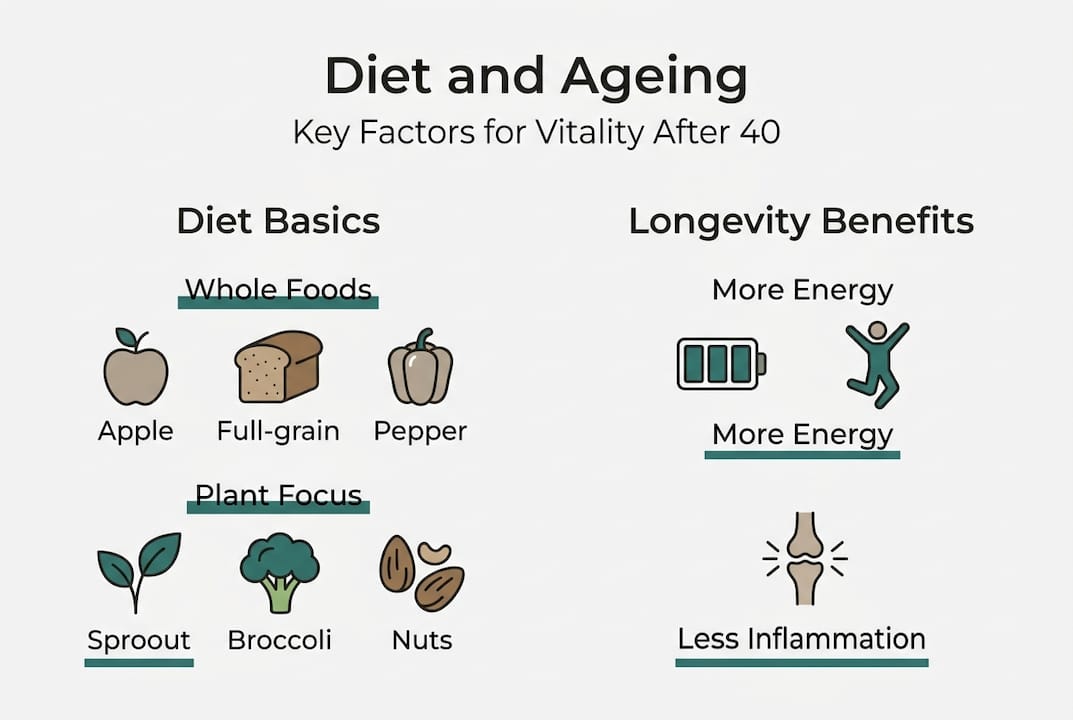
Explorer les classiques des régimes de longévité révèle des points communs : aliments complets plutôt que transformés, abondance de végétaux, sources protéiques de qualité et graisses saines. Ces schémas évitent les sucres raffinés, l'excès de sodium et les gras trans qui accélèrent le vieillissement.
Principes clés partagés dans les régimes de longévité :
- Abondance d'aliments végétaux fournissant fibres, antioxydants et phytonutriments
- Graisses saines issues de l'huile d'olive, des noix, des graines et des poissons gras
- Céréales complètes plutôt que glucides raffinés pour une énergie et des nutriments durables
- Protéines modérées provenant de sources variées incluant légumineuses et poissons
- Aliments transformés, sucres raffinés et graisses malsaines minimaux
Stratégies pratiques d'alimentation et de supplémentation pour la vitalité après 40 ans
Transposer la recherche sur la longévité en pratique quotidienne nécessite des étapes concrètes adaptées à votre mode de vie et à vos préférences. Après 40 ans, les changements métaboliques et les besoins nutritionnels évolutifs rendent l'optimisation alimentaire de plus en plus importante pour maintenir énergie et vitalité. Commencez par augmenter progressivement les portions de végétaux à chaque repas, en visant que les légumes ou fruits occupent la moitié de votre assiette.
- Priorisez la répartition des protéines sur les repas pour soutenir le maintien musculaire, en consommant 25 à 30 grammes au petit-déjeuner, déjeuner et dîner plutôt que de concentrer l'apport sur un seul repas.
- Incluez quotidiennement des aliments fermentés comme le yaourt, le kéfir, la choucroute ou le kimchi pour soutenir la diversité du microbiome intestinal liée à un vieillissement en bonne santé.
- Remplacez les céréales raffinées par des alternatives complètes fournissant plus de fibres, de vitamines B et de minéraux essentiels au métabolisme énergétique.
- Planifiez des heures de repas régulières pour soutenir l'alignement du rythme circadien, qui influence la santé métabolique et les processus de réparation cellulaire.
- Préparez des portions plus grandes de repas riches en nutriments pour plus de commodité, réduisant ainsi la dépendance aux options transformées lorsque le temps ou l'énergie manque.
Les stratégies de supplémentation complètent les améliorations alimentaires en comblant les carences nutritionnelles courantes à partir de la quarantaine. Choisir des suppléments efficaces favorise un vieillissement en bonne santé lorsqu'ils sont associés à une alimentation appropriée, notamment pour les nutriments difficiles à obtenir en quantités optimales uniquement par l'alimentation. Le soutien à la méthylation via des composés comme la bétaïne aide à maintenir la santé cardiovasculaire et l'efficacité de la régulation génétique.
L'énergie et la vitalité diminuent souvent avec l'âge, en partie à cause d'une absorption réduite des nutriments et d'une augmentation des besoins. Une supplémentation ciblée répond à ces changements pendant que les améliorations alimentaires prennent effet. Concentrez-vous sur des options fondées sur des preuves plutôt que sur des produits à la mode sans soutien scientifique.
Astuce pro : Réévaluez vos besoins alimentaires et en compléments tous les deux à trois ans, car le vieillissement modifie les besoins en nutriments. Ce qui fonctionnait à 45 ans peut nécessiter un ajustement à 55 ans en raison des changements métaboliques et d’absorption.
Pièges courants à éviter pour optimiser son alimentation pour la vitalité :
- Négliger une hydratation adéquate, qui affecte l’énergie, la fonction cognitive et le transport des nutriments dans tout le corps
- S’appuyer excessivement sur les compléments tout en maintenant de mauvaises habitudes alimentaires que les compléments ne peuvent compenser entièrement
- Éliminer des groupes alimentaires entiers sans accompagnement professionnel, ce qui peut créer des carences nutritionnelles
- Ignorer les réponses et tolérances individuelles qui varient significativement entre les personnes
- S’attendre à des résultats immédiats et spectaculaires plutôt que de reconnaître des améliorations progressives sur plusieurs semaines et mois
Envisagez de travailler avec un nutritionniste qualifié pour personnaliser les recommandations selon votre état de santé, vos médicaments et vos objectifs spécifiques. La variation individuelle en génétique, composition du microbiome intestinal et conditions de santé existantes signifie que les approches optimales diffèrent d’une personne à l’autre.
Explorer le choix des compléments pour un vieillissement sain vous aide à naviguer dans le marché saturé des compléments avec des critères basés sur des preuves. Recherchez des produits avec une traçabilité transparente des ingrédients, des tests tiers et des dosages conformes aux protocoles de recherche.
Comparaison des compléments populaires qui soutiennent un vieillissement sain
Le marché des compléments offre de nombreux produits prétendant avoir des bienfaits anti-âge, mais la qualité des preuves varie considérablement selon les options. Comprendre quels compléments démontrent une réelle efficacité vous aide à investir judicieusement dans votre santé. Les compléments de soutien à la méthylation comme le TMG (triméthylglycine ou bétaïne) fournissent des groupes méthyle essentiels à la régulation de l’ADN et au métabolisme de l’homocystéine, deux éléments cruciaux pour la santé cardiovasculaire et cognitive.
| Complément alimentaire | Composés actifs clés | Principaux bienfaits | Cas d'utilisation idéaux |
|---|---|---|---|
| TMG (Bétaïne) | Triméthylglycine | Soutien à la méthylation, réduction de l'homocystéine, santé cardiovasculaire | Adultes de plus de 40 ans préoccupés par la santé cardiaque et le vieillissement cellulaire |
| Acides gras oméga-3 | EPA et DHA | Anti-inflammatoire, soutien cardiovasculaire, fonction cognitive | Ceux ayant une consommation limitée de poissons gras ou des marqueurs inflammatoires élevés |
| Vitamine D3 avec K2 | Cholécalciférol, ménaquinone | Santé osseuse, fonction immunitaire, métabolisme du calcium | Personnes avec une exposition solaire limitée ou une carence testée |
| Coenzyme Q10 | Ubiquinone ou ubiquinol | Production d'énergie mitochondriale, protection antioxydante | Adultes de plus de 50 ans ou ceux prenant des statines qui épuisent le CoQ10 |
| Résvératrol | Trans-résvératrol | Activation des sirtuines, effets antioxydants, soutien métabolique | Personnes soucieuses de leur santé cherchant un soutien supplémentaire à la longévité |
Les packs de compléments énergie et vitalité offrent des bénéfices synergiques en combinant des nutriments complémentaires qui ciblent plusieurs voies du vieillissement simultanément. Ces formulations incluent généralement des soutiens à la méthylation, des antioxydants et des cofacteurs du métabolisme énergétique qui agissent ensemble plus efficacement que des compléments isolés.
Lors du choix des compléments, considérez plusieurs facteurs de qualité et d'efficacité :
- Biodisponibilité de la forme spécifique utilisée, car certains composés s'absorbent mal tandis que d'autres entrent efficacement en circulation
- Alignement du dosage avec les recherches montrant des bénéfices, évitant les produits sous-dosés incapables de fournir des résultats
- Interactions potentielles avec les médicaments ou autres compléments que vous prenez actuellement
- Vérification par des tests tiers garantissant la pureté et un étiquetage précis
- Normes de fabrication et transparence de l'approvisionnement en ingrédients par des entreprises réputées
Les approches combinées s'avèrent souvent plus efficaces que la supplémentation en un seul nutriment car le vieillissement implique plusieurs voies interconnectées. Un soutien à la méthylation agit en synergie avec des antioxydants et des composés anti-inflammatoires pour offrir une protection cellulaire complète. Cela explique pourquoi les formulations groupées conçues par des experts peuvent surpasser l'empilement aléatoire de compléments.
Explorer les compléments de méthylation pour le vieillissement révèle des options spécifiquement formulées pour soutenir cette voie biochimique critique. L'efficacité de la méthylation diminue naturellement avec l'âge, rendant le soutien ciblé de plus en plus précieux après 40 ans pour maintenir la santé cardiovasculaire et une expression génétique optimale.
Le moment et la régularité sont très importants pour l'efficacité des compléments. Les vitamines liposolubles comme la D et la K2 s'absorbent mieux avec des repas contenant des graisses saines, tandis que certains composés fonctionnent mieux à jeun. Établissez une routine régulière plutôt qu'une utilisation sporadique pour maintenir des niveaux stables de nutriments soutenant les processus cellulaires continus.
Découvrez des compléments pour un vieillissement sain et la vitalité
Après avoir exploré comment l'alimentation et les compléments soutiennent un vieillissement en bonne santé, vous vous demandez peut-être où trouver des produits de qualité correspondant aux preuves discutées. Vivetus se spécialise dans les compléments formulés scientifiquement, conçus spécifiquement pour la vitalité et la longévité. Les compléments Vivetus® TMG fournissent un soutien à la méthylation essentiel pour la santé cardiovasculaire et la fonction cellulaire avec l'âge.
Pour un soutien complet, le pack de compléments énergie et vitalité combine des nutriments complémentaires ciblant plusieurs voies du vieillissement simultanément. Ces produits formulés par des experts subissent des tests rigoureux de qualité pour garantir pureté et puissance, vous assurant confiance dans ce que vous consommez. Découvrez la gamme complète sur Vivetus pour trouver des options adaptées à vos objectifs de santé spécifiques. Tous les produits sont expédiés à l’international avec livraison gratuite pour les commandes supérieures à 50 €, rendant les compléments premium accessibles où que vous viviez.
Questions fréquemment posées
Quel est le nutriment le plus important pour un vieillissement en bonne santé ?
Aucun nutriment unique ne détermine le vieillissement, mais les soutiens à la méthylation comme la bétaïne, le folate et les vitamines B comptent parmi les plus importants pour la régulation génétique et la santé cardiovasculaire. Un apport protéique adéquat est également essentiel après 40 ans pour maintenir la masse musculaire et la fonction métabolique qui déclinent généralement avec l’âge.
L’alimentation peut-elle vraiment ralentir le vieillissement biologique ?
Oui, les habitudes alimentaires influencent significativement les marqueurs biologiques du vieillissement, notamment la longueur des télomères, les marqueurs inflammatoires et le stress oxydatif. Les études montrent que les personnes suivant un régime méditerranéen ou riche en plantes vieillissent biologiquement plus lentement par rapport à leur âge chronologique, contrairement à celles consommant un régime occidental typique riche en aliments transformés.
À quelle vitesse vais-je remarquer une amélioration de mon énergie après des changements alimentaires ?
La plupart des gens constatent une amélioration initiale de l’énergie en deux à quatre semaines après l’optimisation alimentaire, bien que les bénéfices complets s’accumulent sur plusieurs mois. Des changements immédiats comme une glycémie stable grâce à la réduction des glucides raffinés peuvent améliorer l’énergie en quelques jours, tandis que les améliorations au niveau cellulaire demandent plus de temps.
Dois-je prendre des compléments si je mange sainement ?
Même d’excellents régimes peuvent manquer de certains nutriments difficiles à obtenir en quantités optimales uniquement par l’alimentation, surtout après 40 ans lorsque l’absorption diminue. Une supplémentation ciblée pour soutenir la méthylation, la vitamine D ou les oméga-3 s’avère souvent bénéfique malgré une alimentation saine, notamment pour combler des carences individuelles ou des besoins accrus.
Les compléments coûteux valent-ils leur prix par rapport aux options moins chères ?
La qualité varie considérablement entre les marques de compléments, affectant la biodisponibilité, la pureté et le contenu réel par rapport aux indications sur l’étiquette. Investir dans des produits testés par des tiers et fabriqués par des marques réputées offre généralement un meilleur rapport qualité-prix que des alternatives bon marché pouvant contenir peu de composés actifs ou des contaminants réduisant l’efficacité et la sécurité.